
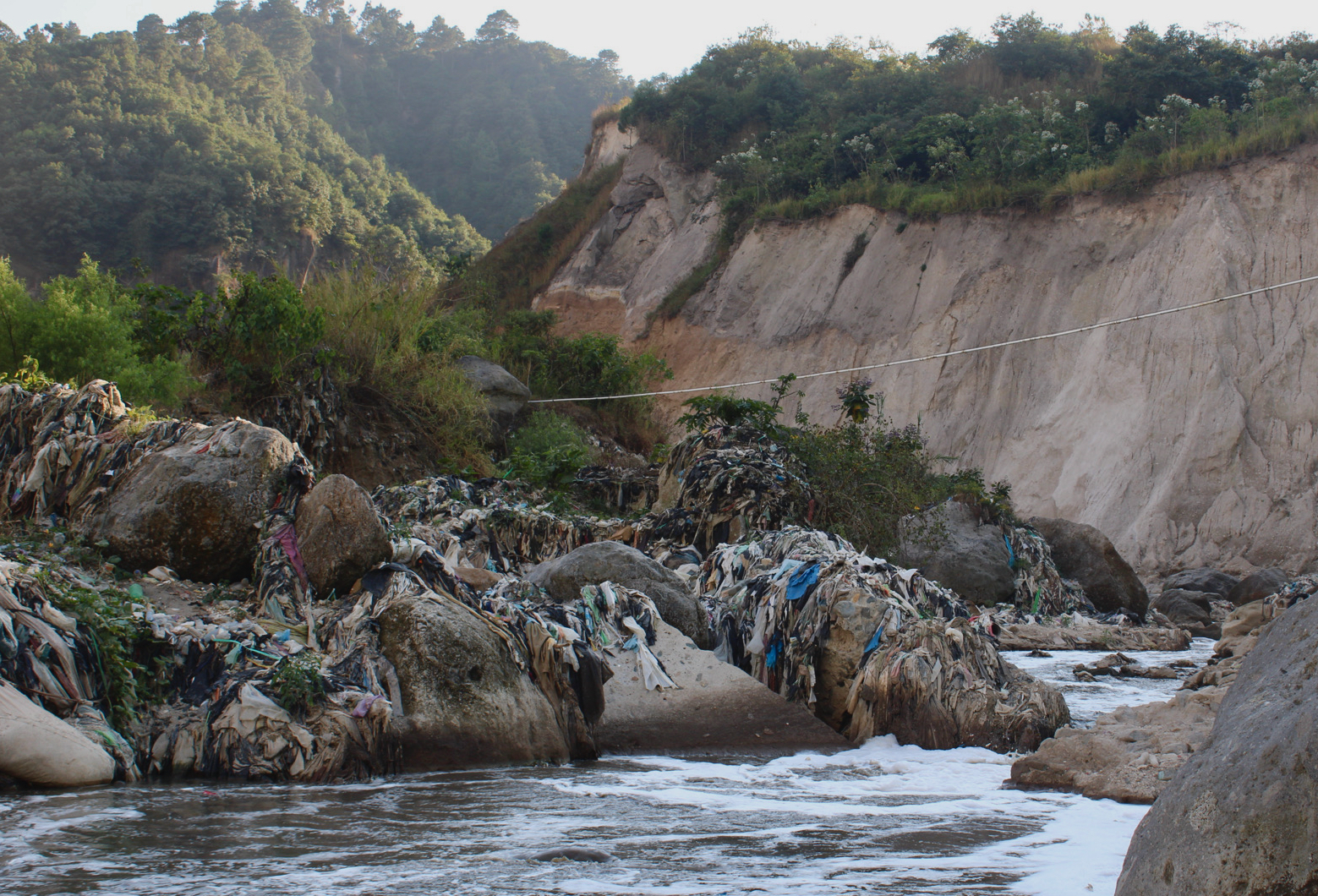
Since the 1990s, the Maya Poqomam Indigenous community of Santa Cruz Chinautla, Guatemala, has endured the impacts of industrial sand mining led by Ladino interests. The land no longer resembles the paradise it once was, and the losses keep accumulating: rivers are polluted, houses are sinking due to land destabilization, and tensions are rising between those resisting extractivism and those working in the industry. While mining companies continue to operate with expired licenses, protected by laws favoring businesses, part of the community has chosen to resist through collective organization.
“They take our best material and send us waste”. Pointing towards the village below, Alejandrolooks me straight into the eye. ““This is an eco-ethnocide taking place here”, he tells me, “please write that in your reports”.
Situated just outside Guatemala City, the indigenous Maya Poqomam community of Santa Cruz Chinautla faces several simultaneous environmental challenges. On the one hand, its rivers are heavily polluted due to garbage and waste waters originating in the capital, and on the other, it’s the site for several industrial sand mines. Stuck between these calamities, the town is hard pressed. “Santa Cruz used to be a paradise”, locals tell me, “but now all is gone”.
According to locals, industrial mining in the area began in the 1990’s. In the beginning, extraction was small-scale (indeed, local Santacruzans have always extracted sand, but manually and for community needs), but in time machinery multiplied and production intensified. Today, several mines operate in the area, few or none of which are locally owned. On the contrary, most mines are owned by Ladinos, residing in and trading with the capital.

Territories and bodies vulnerable to contamination
Why, then, is this destruction taking place and why here? According to American historian Traci Brynne Voyles, one way of understanding the unjust distribution of environmental costs and benefits is through the concept of wastelanding. In her words, wastelanding refers to the process by which “certain environments and bodies are rendered pollutable in ways that are both ideational and material”, meaning that privileged parts of the population work both rhetorically and practically in order to exploit marginalized communities.
For Voyles, this process occurs in two steps, in which the exploiter must first discursively construct the lands sought for as useless or unproductive and then, in a second step, enter them physically in order to extract their resources. Unsurprisingly, this exploitative process does not occur randomly but usually materializes according to hierarchies of class, race and gender, with indigenous communities at extra risk. For this reason, Voyles says, it is usually in the same marginalized communities from which “resources are increasingly extracted” where waste is also “increasingly dumped”.
How, then, do these processes play out in Santa Cruz? What do they look like and how do people respond? To begin with, a basic premise for this destructive extraction of resources from Poqomam territory by outsiders is the unequal relation between the primarily Ladino (or otherwise non-Indigenous) capital and the mainly Mayan countryside. When Ladino-owned mines extract Poqomam sand and leave the community to care for the damage, then, this is not a coincidence but a continuation of centuries of colonial oppression.
An accumulation of losses
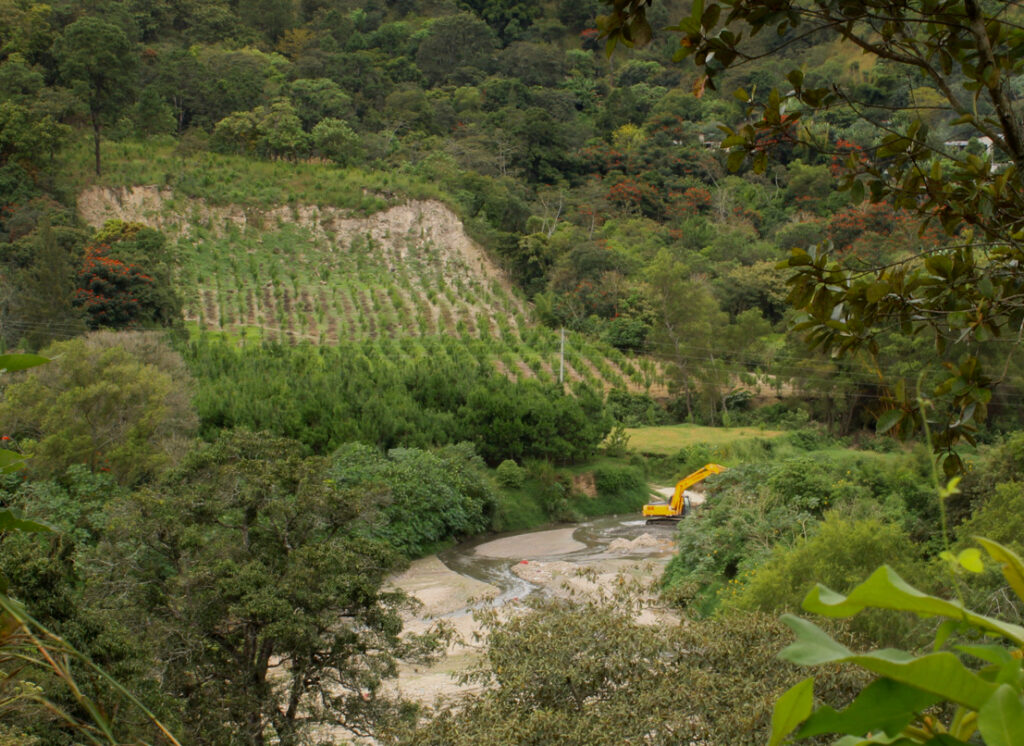
For Santa Cruz’s anti-mining resistance, the main adversary is the Piedrinera San Luis, the biggest mine. Having operated without a valid license since the previous one expired in 2022 (just like, in 2021, that of neighboring mine La Primavera), the resistance is currently working for the license not to be renewed.
According to Guatemalan Mining Law, however (or, at least MEM’s interpretation of it), business can continue as usual for as long as the extension is pending and no community consultation or environmental impact assessment is needed for the issuing of a new 25-year license. In other words, the law is written for the companies.
When the mines extract sand from the riverbanks the natural course of the river is distorted, causing it to compensate the loss of volume with sand from the surrounding area. Consequently, the ground destabilizes and people lose land or housing.
When the mines extract sand from the riverbanks, the ground destabilizes and people lose land or housing.
But look, if the profits leave the community, then surely the costs do too? Not so much. Indeed, for most locals, the relation to the mines is that of loss. Loss of lands, loss of housing, loss of livelihood and – as in the case of the tragic killing of 16-year-old Anílson Alberto Vásquez Chacón, the son of an indigenous authority on April 18th, 2024, presumably by people associated with the mines – the loss of family members.
The reason for this loss varies – heavy road dust, floodings, persecution – but the main one is landslides and erosion. For most locals, it is evident that when the mines extract sand from the riverbanks the natural course of the river is distorted, causing it to compensate the loss of volume with sand from the surrounding area. Consequently, the ground destabilizes and people lose land or housing due to landslides and sinking ground levels.
A shared nostalgia
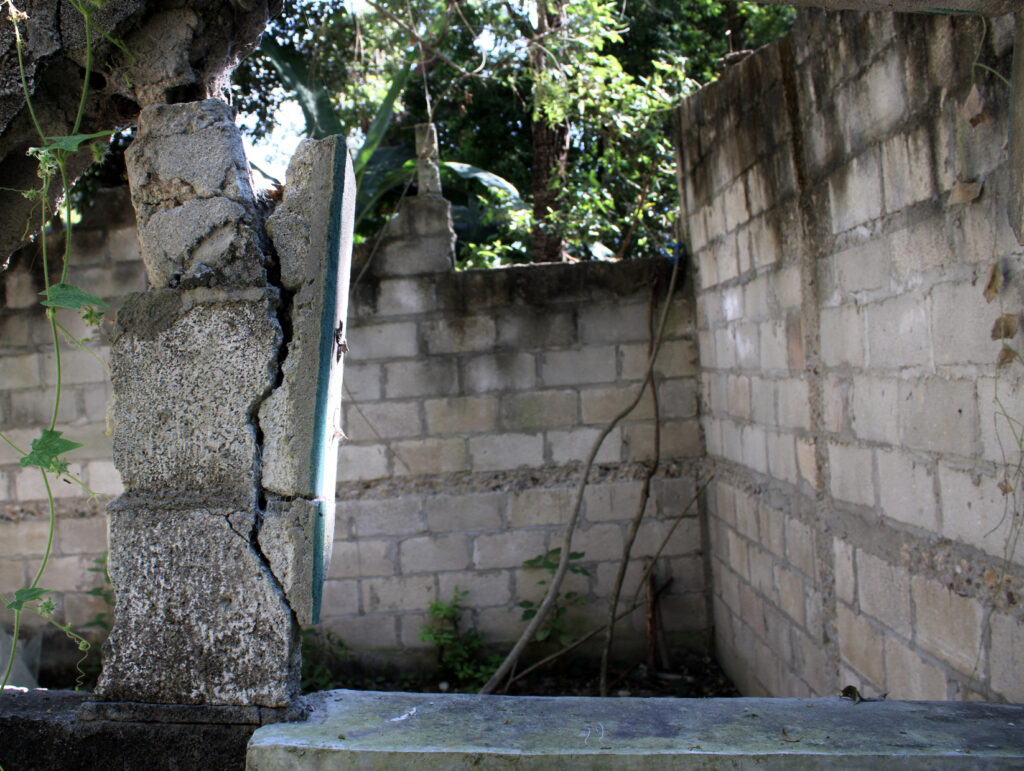
Showing me the dusty slope that was once her patio, artisan Juana says: “Our houses aren’t any good anymore. The terrain sunk at least two meters and we have no other land”. When asked if she can repair it, she answers: “No. We can’t make a good house because it will split and fall. So for this reason we build with sheets of metal. But we have to refill the floor often, because the ground sinks really fast”.
Sadly, the case of Juana is no exception. Strolling around the ruins of his childhood home, resistance member Alejandro tells me: “When I was 8 years old, the mines made us lose our first house. It just turned over. When I was 16, we lost the second one. It’s really sad to think of this because for me this place was paradise”. The double loss of his home caused Alejandro much emotional and economic stress. He continues: “When this happened, I got psychological and economic problems and I almost lost my Poqomam identity. Now I live on the other side of the community and have to build my own house. Previously, we had forest and some animals, but now I lack water, pavement and electricity”. Comparing his situation with that of his ancestors, Alejandro tells me: “My grandfather had 32 manzanas of land and my father had two. But I will never have that much, just because of the mines”.
The mines affect not only the individual, but also the community at large. For this reason, Santacruzans regularly express an almost universal sense of nostalgia, but also of social tension. Reflecting on how Santa Cruz has changed since he was a child, Chico, now a father, says: “It really makes me sad. When I speak to my friends I always miss the riverbanks and want to return there as a father to play and explore the landscape. But this will never happen again – the story won’t be repeated”.
For artisan Julia: “The mines and pollution bury he clay that we use. With so much waste, bags and plastic the clay gets stuck underneath and we don’t find any”.
For artisan Julia: “The mines and pollution bury he clay that we use. With so much waste, bags and plastic the clay gets stuck underneath and we don’t find any”.
Commenting on the conflicting interests of various groups in the community, indigenous authority Bernardo says: “We have to accept that some people gain from the mines, because they work there or transport sand in their truck. So sadly, we have confrontation among ourselves”. One such truck driver is Teodoro. When I ask him about his work he acknowledges the damage, but also the economic need. “It’s true that the extraction is excessive and might be destructive”, he tells me, “but at the same time I want the mines to stay because that’s how I make a living. If I don’t sell sand, how should I buy my food?”. Cutting right to the key question of collective resource management, he says: “Actually, it’s we ourselves who are destroying the community. And why? Because we have to make money to eat and provide education for the kids”.
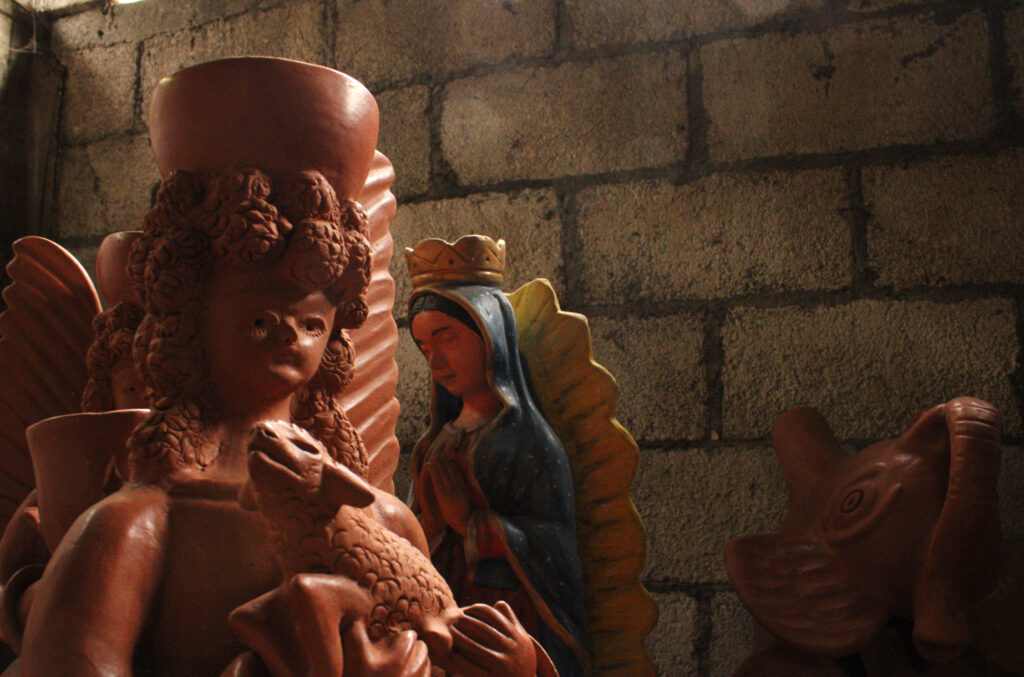
Does this mean the mines make everyone a winner? For artisan Julia who works in the tradition of Santa Cruz’s renowned pottery, the answer is a clear no. “The mines and pollution bury he clay that we use. With so much waste, bags and plastic the clay gets stuck underneath and we don’t find any”. Commenting on the increased risk of getting good clay due to frequent landslides, she says: “Before people used to search for the finer clay, but now they stopped. Actually, there was a man who got buried looking for clay. He lost his life”. Throughout Santa Cruz, pottery is a cornerstone of many household economies, especially for women and single mothers. The mounting lack of quality clay, however, not only means a loss of income, but also of culture. For Juana, pottery is more than just work: “For us, this is a teaching from our ancestors”, she tells me. “This is how we Poqomam women make our living”.
The organization of resistance
With their ancestral territory under attack, parts of the community have decided to resist. Launched in response to the 2022 expiry of Piedrinera San Luis’ mining license, the resistance began with a 21-day roadblock. Drawing upon previous organizational experience within the community, resistance leaders rejected the municipality-linked community development council (COCODEs) and opted for an independent organizational structure. “We know that according to the constitution, we original peoples have the right to our own organizations”, Bernardo tells me. “So we created an indigenous authority”.
The decision to organize does not stem merely from an opposition to the mines, however, but rather from a broader dissatisfaction with the state. Alejandro says: “What quality of life is this state giving us? We have never polluted anything, but with all these corrupt governments since the invasion, they continue to rob us”. “The state doesn’t care about our problems”, he tells me. “Either it doesn’t see them, or it doesn’t care”.
For many members, the fight is existential. Juana tells me: “This struggle has to continue because we are not fighting for ourselves, but for our children. Because if the mines continue to operate, Santa Cruz will soon disappear”.
Juana tells me: “This struggle has to continue because we are not fighting for ourselves, but for our children. Because if the mines continue to operate, Santa Cruz will soon disappear”.
Primarily focused on the cancellation of the pending mining licenses and obtaining compensation for the damage done, the main activity of the resistance is the maintenance of their camp on the road between Santa Cruz and Piedrinera San Luis. There, resistance members meet, discuss and observe the trucks transporting cargo to and from the mine. As several members explain to me, the idea is not only to monitor, but also to show that even if the roadblock is gone, the resistance is not. For many members, the fight is existential. Juana tells me: “This struggle has to continue because we are not fighting for ourselves, but for our children. Because if the mines continue to operate, Santa Cruz will soon disappear”.
For many activists, joining the resistance has been transformative. Although stories of threats and persecution abound, for most the power of resisting outweighs the fears. Here’s Juana again: “When I first joined the resistance, I didn’t know what a manifestation was. But there I understood, and I have learnt many things, like defending my rights as a woman”. After a short pause, she continues: “You know, it feels good to learn about your rights, because practically they don’t care about us indigenous women. But now we took this space, and they will have to listen to us whether they want to or not”. Echoing Juana’s sense of a re-born political self, Daniel says: “I used to be a person without knowledge of the law. But today, thanks to the resistance, I understand more. Today I know that I have rights and that I must fight for them”.
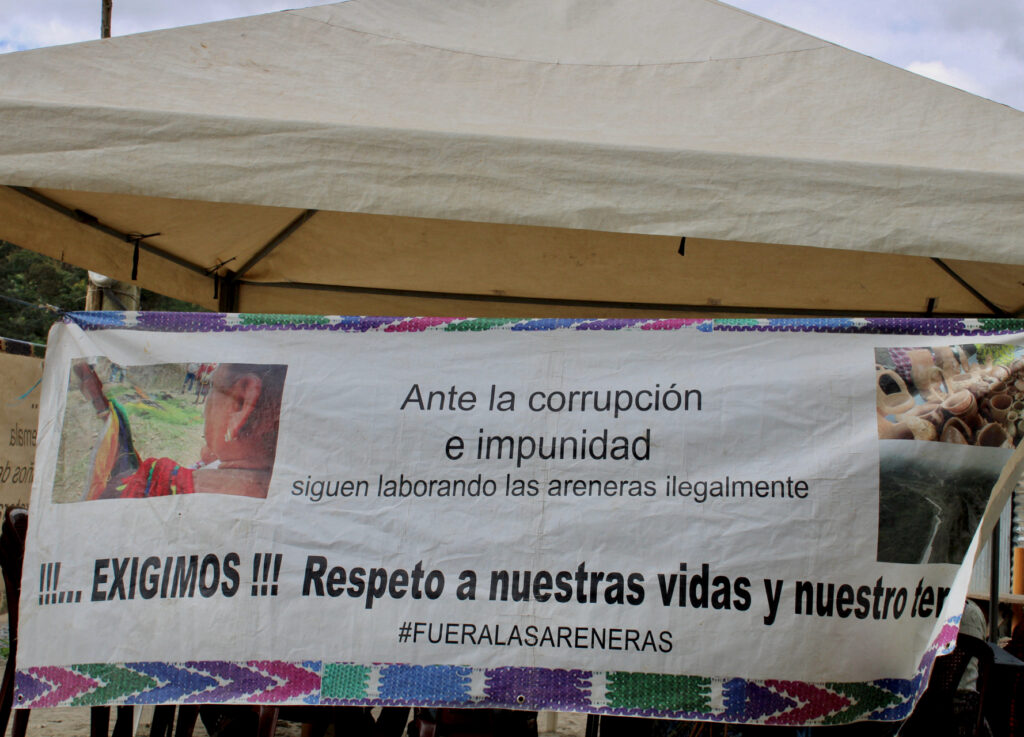
The collective struggle for freedom and self-determination
Today, the story of the sand mines is at a crossroads. Following the installation of progressive president Bernardo Arévalo in January 2024, hopes for a different Guatemala have been high, but according to critics progress is slow and questions remain. Will the Arévalo government guarantee the rights of indigenous communities in the face of business interests? Will the Ministry of Energy and Mines decide on San Luis’ and La Primavera’s licenses and, if so, will the community be consulted and an environmental assessment made?
Whatever the answer, for Alejandro, the fight is bigger than just the mines. Rather, it is a struggle for freedom and self-determination. Envisioning his hopes for the future of the Poqomames, he tells me: “You don’t just need land and water”. “What you really need”, he says, “is the fire to live freely – free from pollution and oppression!”.
For security reasons, all names in the article are fictitious.
Axel Björklund is a political scientist and anthropologist from Sweden, whose master project centered on mining and resistance in Santa Cruz, Guatemala. He is currently working as a political secretary for the Swedish Left Party in the Stockholm area.