

Promoted by the Peruvian state, informal gold mining causes environmental damage, disrupts local culture, and weakens the community organization system. Additionally, the influx of outsiders poses serious public health risks by contributing to the spread of sexually transmitted diseases, increasing HIV cases, and causing skin conditions. As long as illegal mining continues to receive congressional support and thrives on corruption, the Awajún Autonomous Territorial Government will take action to prevent further encroachment on its territory.
Gold mining in Awajún territory dates back to 1549, during the Spanish colonial period. At that time, neither Peru nor Ecuador existed. Early anthropological studies identified the Jíbaro peoples—Shuar, Achuar, Wampis, and Awajún—as the main inhabitants of the northwestern Upper Amazon, particularly in the Chinchipe, Zamora, Morona, and Marañón river basins. During this period, numerous mining camps were established as centers for demographic expansion, including Valladolid, Sevilla de Oro, Logroño, and Santiago de las Montañas. However, following the Jíbaro uprising of 1599, most of these initial camps were destroyed.
According to oral sources preserved to this day, while the increased gold tax imposed by the governor of Macas pushed the ancestors to their limit, the root cause of the social uprising that ended foreign presence in Awajún territory was the introduction of new diseases, sexual violence, and the inhumane treatment inflicted upon the native population.
The recent history of gold mining in the high Amazon has deep, centuries-old roots, and its current phase represents the intensification of the extractivist project, driven primarily by accumulation-driven ambition. Gold mining poses a direct threat to the environment and, above all, to Indigenous Peoples and their systems of territorial control, leading to the destruction of their socio-economic structures and cultural identities. The recurring assaults on Indigenous Peoples and the environment continue with the same intensity, albeit under different forms, much like the rubber boom, which claimed thousands of lives.

Mining concessions in the Amazon and illegal gold exploitation
According to data from the Ministry of Energy and Mines, gold production from January to August 2024 reached 69.1 million fine grams, reflecting a 10.5% increase compared to the same period in 2023 in which 62.5 million fine grams were produced. Yanacocha S.R.L. is the country’s leading producer. This figure does not account for illegal gold production.
The Peruvian Institute of Economics (IPE) estimates that illegal gold exports reached approximately $6.84 billion dollars in 2024, a 41 percent increase from 2023. It also reports that Peru exports 44 percent of all illegal gold in South America.
Between 2020 and 2024, the Geological, Mining, and Metallurgical Institute (INGEMMET) granted 510 mining concessions in the departments of Amazonas, Loreto, San Martín, and Ucayali. Of this total, 17 concessions were granted, in the past year, in the department of Loreto alone. Meanwhile, the company Sociedad Minera Vicus Exploraciones, acquired by the Canadian company Palamina Corp in early 2024, holds 92 records in San Martín and Ucayali. Additionally, Hannan Metals Perú, also Canadian-owned, holds 61 concessions in San Martín.
In the Awajún territory, located between the Marañón and Cenepa rivers, there are 19 mining concession requests that cover a total of 11,100 hectares. Of these, 11 have already been granted, representing 5,900 hectares of land. These concessions affect the riverbanks and shorelines.
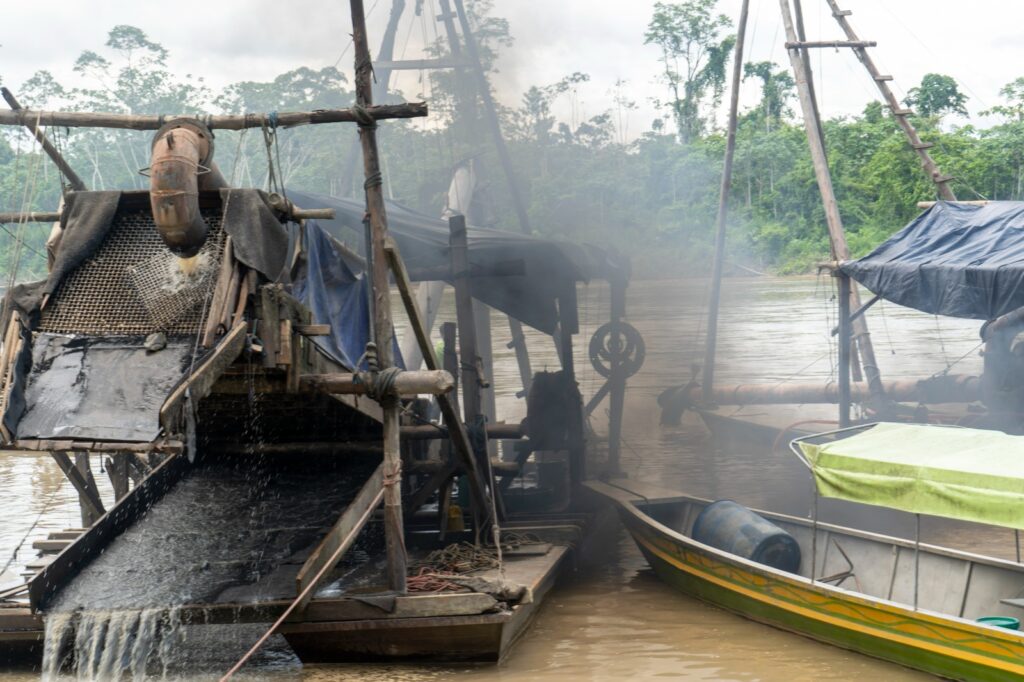
The camouflage of foreign capital
Although mining concessions are prohibited along riverbanks, headwaters, lagoons, and in the buffer zones of Protected Natural Areas in Peru, reality contradicts the regulation. A prominent example of the discrepancy is in the Cordillera del Cóndor. In 2004, the government, through the National Institute of Natural Resources (INRENA), reached an agreement with the Awajún people to create the Ichinkat Muja National Park, as part of a consultation process. However, the consultation was ignored by the State, and mining activities were prioritized: 65,000 hectares were cut from the park’s initial 153,000-hectare area.
The national park was created in 2007 through Supreme Decree 023-2007-AG, and covered a total area of 88,477 hectares. In the excluded area, 111 mining concessions were granted without considering the opinion of scientists who had classified the biodiversity of the region as a high priority for conservation. Additionally, they disregarded the fact that the areas requested for concession were also headwaters.
Article 71 of the Political Constitution of Peru establishes that foreigners are prohibited from acquiring or owning, under any title, mines, lands, forests, or water within 50 kilometers of the borders. However, foreign interests, using camouflage mechanisms, create national companies to acquire concessions that appear domestic. This is the case with Dorato Perú, whose parent company is the Canadian company Dorato Resources, an ally of Afrodita.
Regardless of whether these companies exploit gold in their acquired concessions or not, the key issue is whether the constitutional mandate, which prohibits foreigners from engaging in any mining activity, directly or indirectly, within fifty kilometers of the border, is being respected.
In troubled waters, fishermen profit
The policy of economic promotion for national development is both inadequate and criminal. On one hand, it is inadequate because our representatives are unwilling to support the formal economy. Instead, they prioritize corruption within the context of illegality.
Additionally, it is criminal because informal mining practice have reached such extremes that they harms both biodiversity and the environmental health of local populations. The state has rewarded those who destroy headwaters, riverbanks, and biodiversity by giving them deadlines to comply with the law through the Comprehensive Mining Formalization Registry (REINFO).
The REINFO program came into effect in June 2017 and under this law, 90,265 registrations were submitted. However, only 2,108 of these successfully completed the formalization process. The rest continued to operate illegally with the approval of the Congress of the Republic, which granted multiple extensions. Recently, Law 32213 was enacted, which through its third Supplementary Provision, extendeds the validity of REINFO until June 30, 2025, with the possibility of further extensions.
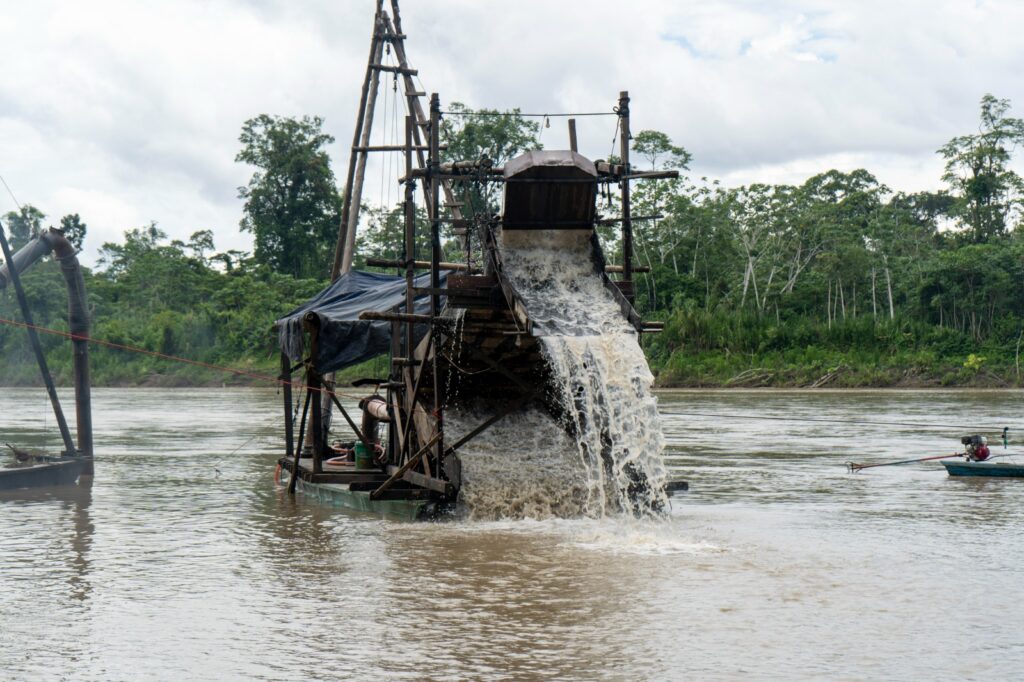
Mining crisis in the Awajún territory
Currently, the Awajún people face several critical threats within four highly concerning geographical hotspots. The first is Tambo, located in the Cordillera del Cóndor, where illegal gold mining is destroying the headwaters that supply the Comaina and Cenepa rivers, each tributaries of the Marañón River. This hotspot affects the lives and health of over 12,000 Awajún inhabitants, along with having significant environmental and biodiversity impacts in the area.
In addition, the population along the Cenepa River is facing alluvial gold extraction, with more than 70 dredges operated by informal agents, mostly from Madre de Dios. Contaminated with mercury, the Cenepa River poses a risk to the population that depends on its water and hydrobiological resources. The third critical area is the Santiago River, which suffers the direct impacts of over 30 dredges. The fourth hotspot is Saramiriza, where illegal alluvial gold mining is also taking place, with around 15 dredges present.
The Awajún Autonomous Territorial Government (GTAA), in coordination with the community and environmental police, has carried out a series of community prohibiting actions in Santiago, Cenepa, and Saramiriza. Thanks to coordinated efforts, the National Police and the Armed Forces, following orders issued by the Environmental Prosecutor’s Office, have managed to destroy 20 dredges in Awajún territory over the past 15 months. Despite these efforts, the foundations supporting the presence of illegal mining in these critical areas have not been dismantled.
Through the GTAA, the Awajún people aim to implement alternative methods of territorial control and surveillance. Over the past 18 months, they have promoted the creation of community police forces and organized training programs to support the development of their roles with the assistance of the National Police of Peru.

In conclusion
Illegal mining operates in complicity with state authorities, including the Congress of the Republic, which enables thousands of environmental criminals to destroy the Amazon by legitimizing their actions. In this way, the informal mining sector is strengthened, turning ongoing extensions for formalization into a recurring modus operandi.
The rise in gold prices, at the international level, is the main driver of the proliferation of mining across nearly the entire Peruvian Amazon. This situation is worsened by the state’s passive approach and the insufficient budget allocated for patrols. Moreover, one of the key factors contributing to the expansion of illegal gold mining is corruption within the authorities responsible for monitoring these activities.
In this context, it is crucial to strengthen the internal territorial control system by establishing key surveillance posts and conducting patrols at critical points. The entry routes for logistics and machinery used in illegal gold extraction from rivers must be blocked. Achieving this requires sufficient enough resources to ensure continuous monitoring.
The GTAA is promoting policies aimed at combating illegal mining with the goal of eradicating this scourge from its territory. To achieve this, it is essential to foster alliances that influence at both national and international levels, ensuring that gold-importing countries are aware of the products’ origin. In this regard, identifying the gold’s route from its source through an effective traceability processes is urgent.
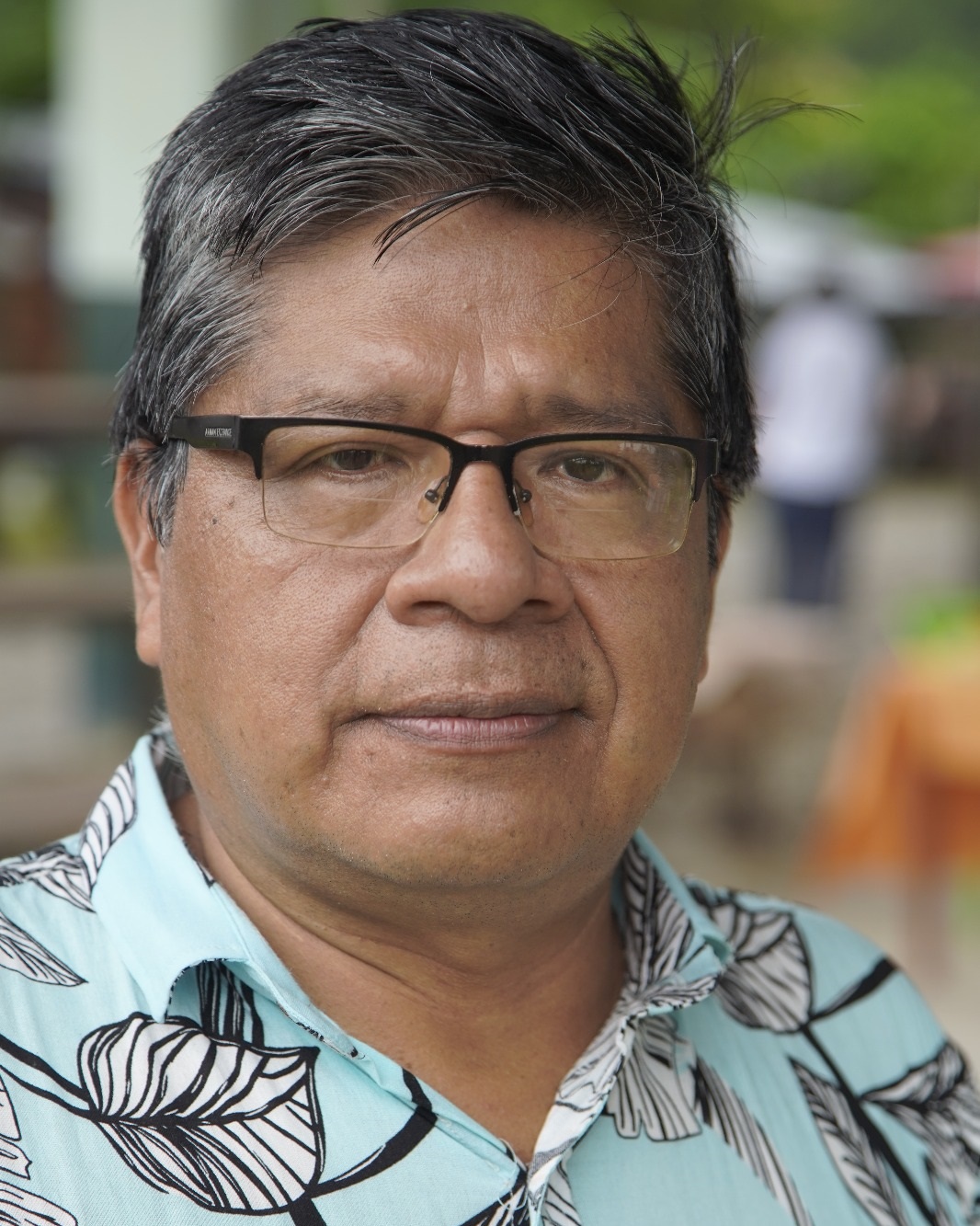
Gil Inoach Shawit is the first Pamuk (governor) of the Awajún Territorial Autonomous Government (GTAA). Previously, he served as president of the Interethnic Association for the Development of the Peruvian Jungle (AIDESEP) and as an advisor to the Coordinator of Indigenous Organizations of the Amazon Basin (COICA). In 2021, he published Between Dependency and Freedom: Always Awajún.