

In 2024, Colombia became the first country in the Americas to recognize the fundamental right to an education that respects the social, cultural, linguistic, and territorial specificities of Indigenous Peoples. This historic milestone is the result of decades of Indigenous struggle and political building led by the communities and their organizations. It also reflects the Colombian state's growing openness to creating public systems that respond to the needs and rights of Indigenous Peoples.
“Self-determined education is rooted in the ability of each and every community involved to guide, lead, organize, and shape educational processes and projects from a critical perspective on the very model of education they seek to transform.”
— Graciela Bolaños
Colombia is home to an Indigenous movement that has become a reference point for various social organization processes across Latin America. According to the most recent population census conducted in 2018, 4.4% of the country’s population identifies as Indigenous—that is, 1,905,617 people out of a total of 48,258,494 inhabitants. This population comprises 115 unique Indigenous Peoples, and 65 Indigenous languages that are grouped into 13 language families and still spoken across the country. The department with the largest Indigenous population is La Guajira, with 394,683 inhabitants, followed by Cauca, with 308,455.
It is precisely in Cauca where the Indigenous movement has grown strongest. Its development dates back to the founding of the Regional Indigenous Council of Cauca (CRIC) in 1971, in the context of broader popular struggles—especially agrarian ones. The movement was founded on the principles of Unity, Land, and Culture, with Autonomy added later. The council’s early objectives included recovering land within Indigenous reserves, strengthening Indigenous councils (cabildos), refusing to pay rent (terraje), raising awareness of Indigenous laws, demanding their fair application, defending Indigenous history, language, and traditions, and “training teachers to educate in accordance with the Indigenous context and in the corresponding Indigenous languages.”
Within these struggles, education was defined as a core component of broader organizational process: doing education was doing politics, and doing politics was doing education. Today, more than 50 years later, the Indigenous movement has solidified a concept developed by the communities themselves: Educación Propia (Self-determined Education). This concept has guided the development of the Indigenous Self-Education System (Sistema Educativo Indígena Propio, SEIP), a national public policy designed by and for Indigenous Peoples—something unequaled elsewhere in the region. It is this journey, which began with the CRIC, to which we turn our attention now.
The Path Toward Self-Determined Education
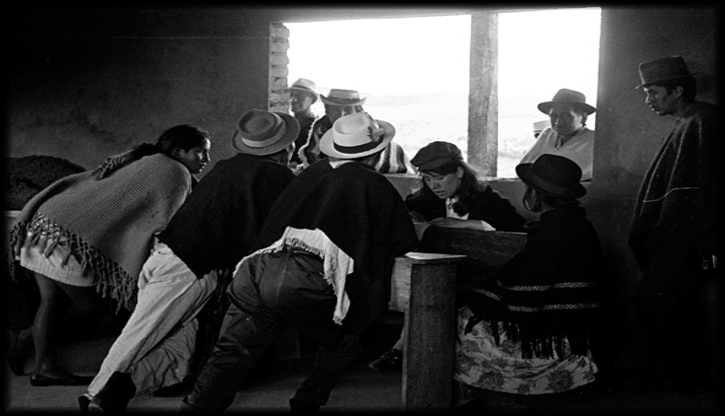
In the organization’s early days, educational efforts and training were focused on land recovery. The goal was for communities to recognize their situation, defend their rights, and gain support to legitimize their organizational actions. Training sessions explored the realities of communities and territories, their different forms of organization, the history of the country and of Latin America, national and international Indigenous legislation, and the dominant structures implicated in land ownership. At the same time, a literacy program took place, as many community members could neither read nor write. Education was not directed at children, but rather at building the community’s collective capacity for political organizing.
A few years later, in 1978, CRIC’s Bilingual Education Program was formally established. The project was grounded in a critical approach to the role of the official school system, which Indigenous communities viewed as an external institution that undermined their language and culture in order to reshape them. From this perspective, communities reclaimed the borrowed school and transformed it into a community-based one—turning it into a space of resistance, a platform for imagining and creating an education from within. The school was not seen as an end in itself, but as a tool for strengthening the political fabric of the entire community.
In addition, the first CRIC schools were established in communities already engaged in land recovery processes, with the aim of strengthening the path of collective organization. A central focus of these self-managed schools was the training of community-based teachers—individuals who emerged from the early seeds of leadership and who would later become the first bilingual educators. These individuals had not received formal training as teachers, but they were respected leaders, knowledgeable and deeply committed to the struggles of their peoples. For the organization and its goals, they were the most suitable people—pillars of resistance capable of shaping new ways of doing education.
This alternative education project, developed from within Indigenous communities, was identified more than 40 years ago as Educación Propia (Self-Determined Education). It was part of broader Latin American initiative aimed at affirming Indigenous cultures and languages. What distinguished it was the centrality of its political character and the guiding principle of autonomy in all educational processes. Educación Propia was defined not so much in terms of ownership, but through the concepts of relevance and self-determination. It was considered “propia” (their own) because Indigenous peoples had control over the frameworks and content of an educational project aligned with a specific vision of society—one committed to recovering Indigenous cultures and identities, and to advancing political struggles for Buen Vivir (Collective Well-Being).
The First Country in the Americas to Recognize the Right to Self-Determined Education
Another key element that contributed to the advancement of Educación Propia in Colombia was the Proyecto Educativo Comunitario (PEC, or Community-Based Education Project), which was extended not only to Indigenous communities but also to other ethnic groups such as the Romani people and Afro-descendant communities. The PEC involved the development of educational guidelines rooted in a community-based perspective and reoriented education to reflect the worldviews of local cultures and communities. When it was introduced in 1996, it focused on formal schooling, as this was the most visible educational setting for communities. However, its main objective was to go beyond schools as the sole spaces for learning and to link education with the life projects of the communities.
By the late 1990s, the Regional Indigenous Council of Cauca (CRIC) began developing the Sistema Educativo Propio (Self-Determined Education System), which acknowledged the diverse learning processes of Indigenous communities beyond formal schooling. At the same time, the system identified the levels of guidance and action needed to implement Educación Propia, with the active participation of authorities, organizational structures, and the broader community. Nationally, the system gained formal recognition in 2009 through participation in the Comisión Nacional de Trabajo y Concertación para la Educación de los Pueblos Indígenas (CONTCEPI, or National Commission for Dialogue and Cooperation on Indigenous Peoples’ Education), which was created in 2007 as a space for jointly developing public policy guidelines for Indigenous education in Colombia.
In this context, the system was renamed Sistema Educativo Indígena Propio (SEIP, or Indigenous Self-Determined Education System) to distinguish it from other sistemas propios (self-managed systems) that might emerge but were not necessarily Indigenous. From that point on, work began on developing a clear profile of the SEIP based on the diverse perspectives of the Indigenous peoples involved. This work led, later, to the drafting of a legal framework to guarantee the fundamental right to Educación Propia for the 115 Indigenous peoples officially recognized in Colombia. In 2024, with the formal adoption of this legislation, Colombia became the first country in the Americas to recognize the fundamental right of Indigenous peoples to an education that respects their social, cultural, linguistic, and territorial specificities.
Recognition by the Colombian State
One of the defining characteristics of the organizational and educational dynamics of the Indigenous movement in Colombia has been the relative openness of the State, which has led to the formal recognition of a range of Indigenous rights. These recognitions are the direct result of grassroots struggles, legal advancements, and initiatives developed by Indigenous organizations themselves. This process has been reflected in differentiated policies and legal frameworks that support the autonomy and rights of Indigenous peoples across various sectors—territory, education, health, and Indigenous justice systems.
Several key organizational achievements are embodied in the development of comprehensive systems designed to guide public policy and address the specific needs of Indigenous communities. Among these are the Sistema de Salud Propia Intercultural (SISPI, Intercultural Indigenous Health System), the Sistema de Autoridad Territorial Económica Ambiental (ATEA, Territorial, Economic, and Environmental Authority System), the Sistema de Administración y Gestión Propia (SAP, Self-Managed Administration and Governance System), the Sistema de Gobierno Propio (SGP, Indigenous Self-Government System), and the Sistema Educativo Indígena Propio (SEIP, Indigenous Self-Determined Education System). All of these are supported by differentiated public policies that acknowledge and protect Indigenous autonomy.
Indigenous Self-Determined Education (Educación Propia) acknowledges the existence of multiple ways, moments, and spaces for learning—many of which do not necessarily take place within the School, even though the School remains a vital path embraced by Indigenous organizations. Today, Colombia is home to a special-status Indigenous university: the Universidad Autónoma Indígena Intercultural (UAIIN). Across Indigenous territories, diverse educational processes are flourishing, including the training of women and youth, the strengthening of the Indigenous Guard, cultural and linguistic revitalization initiatives, seedbeds for language learning, centers for training and research, political education schools, programs for young people and adults, and networks that weave together ancestral knowledge. This complex educational fabric has been made possible by decades of struggle—struggles that have expanded the meaning of education into a political project guided by the principle of Buen Vivir (Living Well, or collective well-being rooted in harmony and balance).
As such, the Indigenous Self-Determined Education System (SEIP) has played a key role in cultivating numerous essential achievements for Indigenous organizations in Colombia: the search for and reconnection with cultural roots; the recognition, appreciation, and active use of ancestral languages; the research and implementation of community-based pedagogies rooted in territory; the recovery of collective governance structures; the understanding and experience of knowledge from within Indigenous languages and ways of thinking; and, above all, the recognition that it is possible to build education from within—education that is aligned with the struggles, identities, and political visions of Indigenous peoples and their organizations.

Libia Tattay Bolaños is an anthropologist from the National University of Colombia and holds a Master's degree in Social Sciences from the Latin American Faculty of Social Sciences (FLACSO Ecuador). She has provided pedagogical support to the Consejo Regional Indígena del Cauca (CRIC) through the Intercultural Bilingual Education Program and the Universidad Autónoma Indígena Intercultural (UAIIN).d