
Bolivia arrives at COP17 with Indigenous territories as part of its strategy to conserve biodiversity. But deforestation, land encroachment, disputes over land, and the lack of information on land tenure expose an underlying tension: meeting global conservation targets will not be possible if the rights of Indigenous Peoples are not fully guaranteed.
In October, the world will gather in Armenia to take stock of a promise made four years ago in Montreal, Canada: to halt and reverse biodiversity loss by 2030. Halfway to that deadline, governments will have to show how much progress they have made toward meeting the 23 targets of the Kunming-Montreal Global Biodiversity Framework, including the ambitious challenge of conserving at least 30% of the planet’s lands and waters.
In other words, governments will face an exam to answer a simple but decisive question for the health of the Earth: are they really doing what they promised to halt the destruction of nature and restore lost biodiversity? Bolivia is one of the countries expected to show what it has done. Before facing that exam, at COP17 of the Convention on Biological Diversity (CBD), to be held in Yerevan, Armenia, from October 19 to 30, 2026, countries first had to account for their progress. They did so through their Seventh National Reports (7NR), in which each government details the measures it has taken and the results it has achieved.
The deadline was February 28, 2026. These reports will provide input for the first global review of collective progress. Bolivia also submitted its report, a document that makes it possible to reconstruct—from the State’s official account—the progress it claims to have made and the difficulties it acknowledges.
The Great Challenge
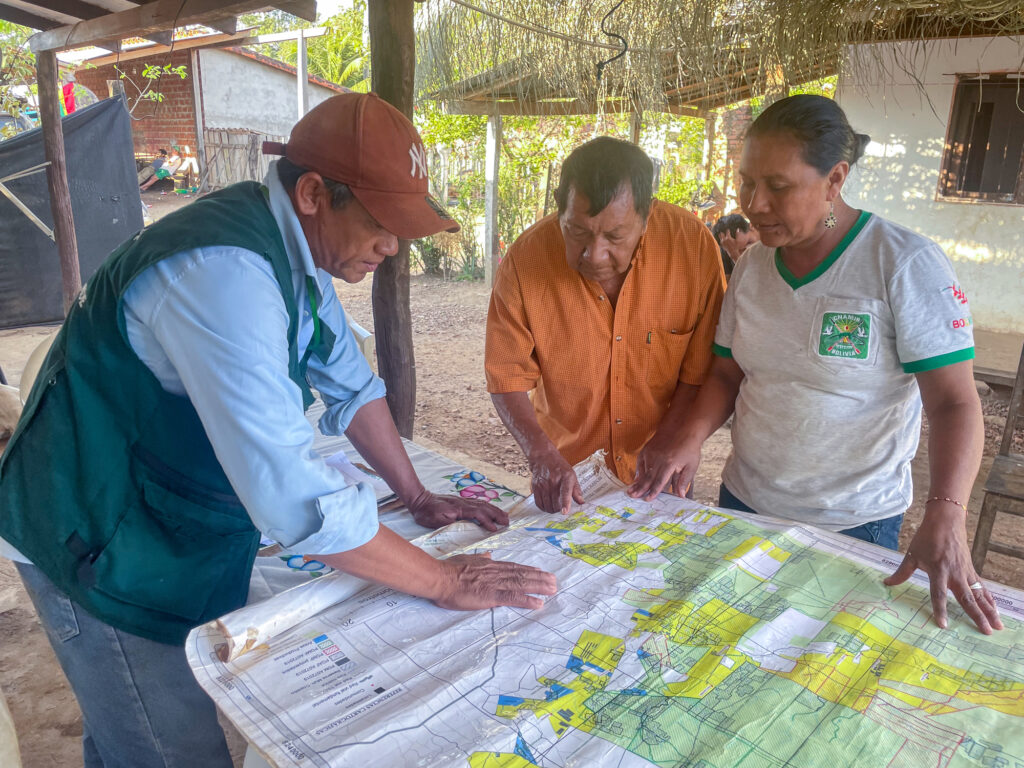
In 2022, during COP15 of the Convention on Biological Diversity, countries adopted the Kunming-Montreal Global Biodiversity Framework and laid out a roadmap toward a world living in harmony with nature by 2050. To meet that challenge, they established 23 targets for 2030 that not only commit governments to halting biodiversity loss, but also place Indigenous Peoples and local communities at the center—as rights holders and essential actors in the conservation of their territories and ways of life.
This relationship between conservation and Indigenous rights runs throughout the Framework. It is particularly evident in Targets 1 and 3. The first calls for spatial planning that reduces the loss of areas of importance for biodiversity while respecting the rights of Indigenous Peoples and local communities. Target 3, known as the 30×30 target, establishes that conservation of at least 30% of the planet’s lands and waters must respect these peoples’ rights over their traditional territories. The message is clear: biodiversity conservation cannot be separated from Indigenous Peoples. So, what has Bolivia done over the past four years to fulfill the commitments it made?
If Indigenous territories are part of Bolivia’s strategy to conserve biodiversity, what is actually happening to their forests in the face of deforestation, land encroachment, and the other pressures the State itself acknowledges?
If Indigenous territories are part of Bolivia’s strategy to conserve biodiversity, what is actually happening to their forests?
In its Seventh National Report, prepared by the General Directorate of Biodiversity and Protected Areas, the Bolivian State maintains that Indigenous territories form part of its conservation strategy. Without providing any figures, the document reports progress in the titling of new Tierras Comunitarias de Origen (TCOs) / Territorios Indígena Originario Campesinos (TIOCs), the development of life plans, and the strengthening of Indigenous forms of governance. It also highlights the creation of conservation areas under Indigenous management, as well as initiatives in forest management, sustainable use, restoration, and territorial monitoring.
But the same report points to a more complex picture. Bolivia acknowledges land encroachment, conflicts over land use and overlapping rights, as well as pressures stemming from extractive activities, agricultural expansion, and illegal settlements. It also admits difficulties in updating and harmonizing life plans and, above all, a lack of information to measure land-use change and land tenure in ancestral territories and local communities. The Document states: “No Data Available”.
The paradox is significant. Bolivia presents Indigenous territories as key to conservation and to the international target of protecting at least 30% of the planet’s lands and waters. Yet when it comes to showing what is actually happening within those territories, the State itself acknowledges that it still lacks the data needed to report on one of the indicators established by the Global Biodiversity Framework. If Indigenous territories are part of Bolivia’s strategy to conserve biodiversity, what is actually happening to their forests in the face of deforestation, land encroachment, and the other pressures the State itself acknowledges?
Forests Under Pressure
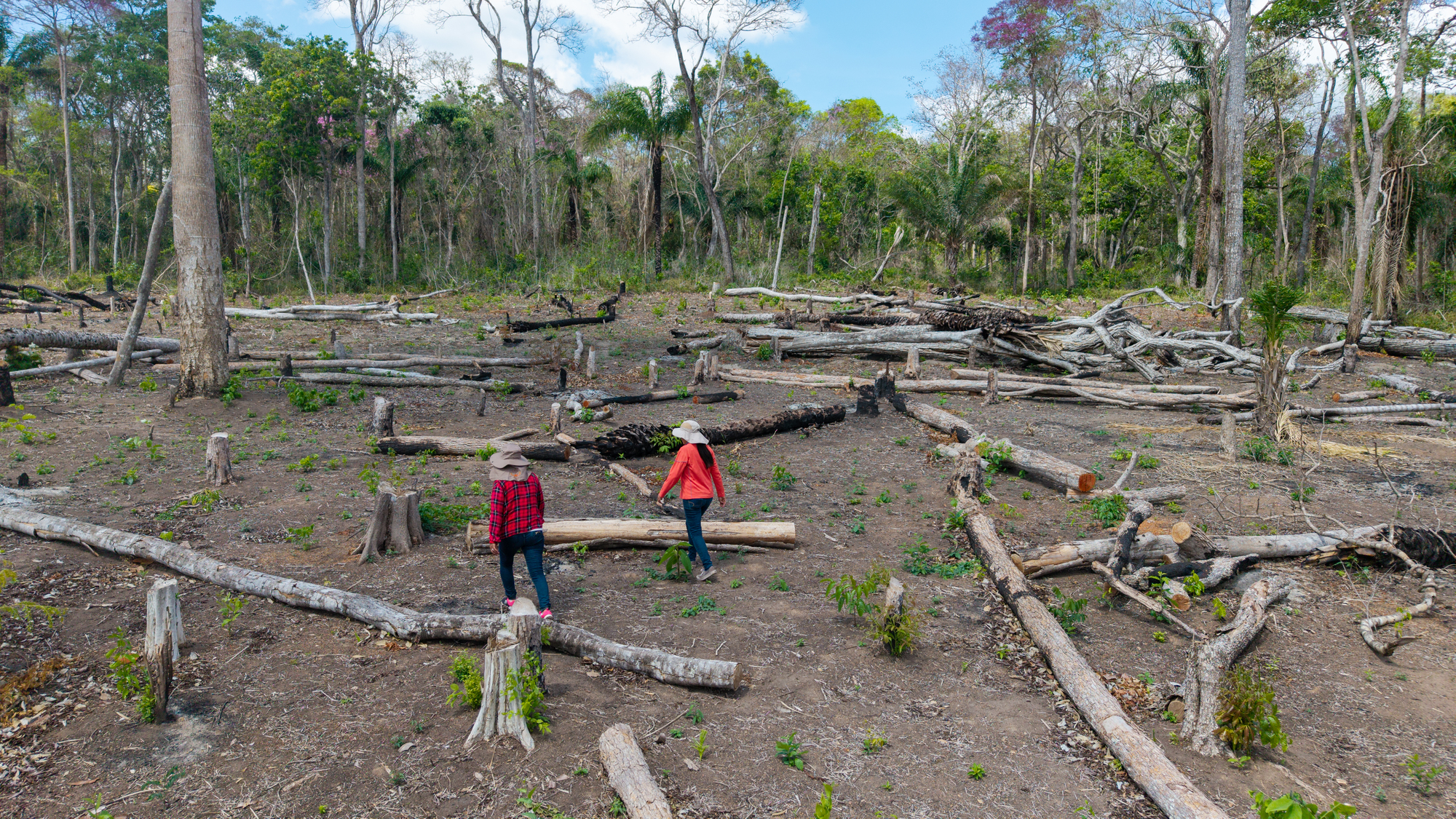
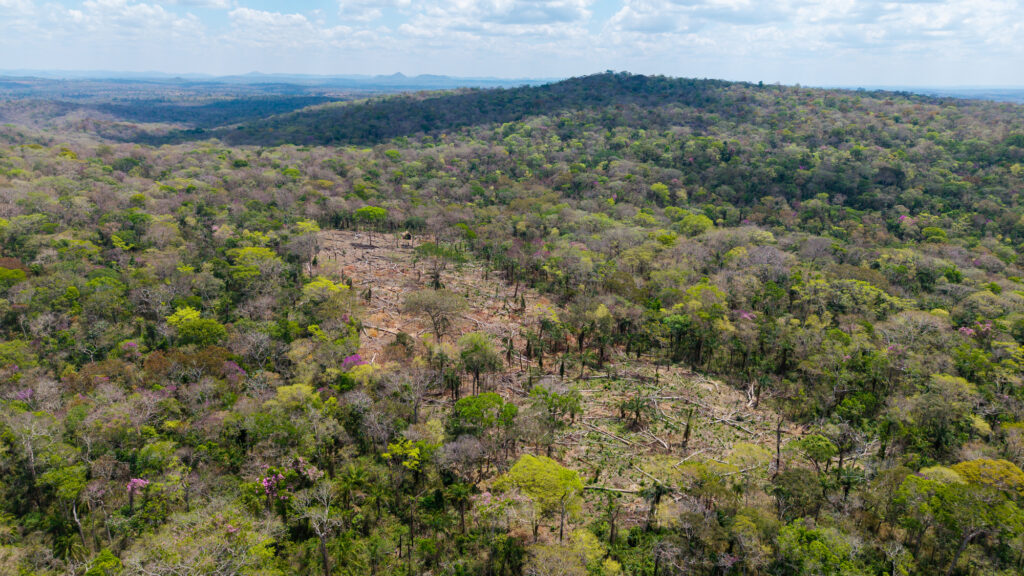
An investigation by Amazonía Traficada—a journalism project supported by the Pulitzer Center, Mongabay Latam, RAI Bolivia, and Asuntos Centrales—used satellite data to examine a key region for conservation: Bolivia’s Indigenous Amazon. The investigation analyzed deforestation within 48 titled Indigenous territories in Bolivia’s Amazon basin and found that, between 1986 and 2024, these ancestral territories suffered a cumulative loss of 257,000 hectares of forest. That figure represents 3.4% of the 7.6 million hectares deforested in Bolivia during the same period.
To determine how much of that deforestation was legally authorized, the investigation cross-referenced the data with forest-clearing permits issued by the Authority for the Social Oversight and Control of Forests and Land (ABT) between 2003 and 2023. Records show that, over those two decades, the institution authorized the clearing of nearly 80,000 hectares of forest in 41 Indigenous territories. Yet only 17,900 hectares within those authorized areas actually lost their forest cover. Most of the forest loss occurred outside areas where clearing had been authorized.
In other words, between 2003 and 2023, 168,670 hectares were deforested in areas without authorization. The ratio gives a sense of the scale of the problem: for every hectare cleared within an authorized area, more than nine were cleared outside authorized areas. In other words, nearly 90% of the forest loss recorded in Amazonian Indigenous territories during that period occurred outside State authorization mechanisms. The pressure on these territories is part of a nationwide trend. A World Resources Institute (WRI) report shows that in 2025 Bolivia once again ranked second in the world for primary forest loss, behind only Brazil.
A Territorial Struggle with No End in Sight
The pressure on Indigenous territories is not limited to forests. It also extends to land tenure and the legal security of these territories. In its Seventh National Report, Bolivia states that it has expanded the area covered by TCOs/TIOCs through new land titles, although it does not specify how many hectares were incorporated.
However, cross-referencing data from research conducted by the Centro de Estudios Jurídicos e Investigación Social (CEJIS) and the Centro de Investigación y Promoción del Campesinado (CIPCA) shows that the struggle of Lowland Indigenous Peoples for the recognition, titling, and defense of their ancestral territories is far from over.
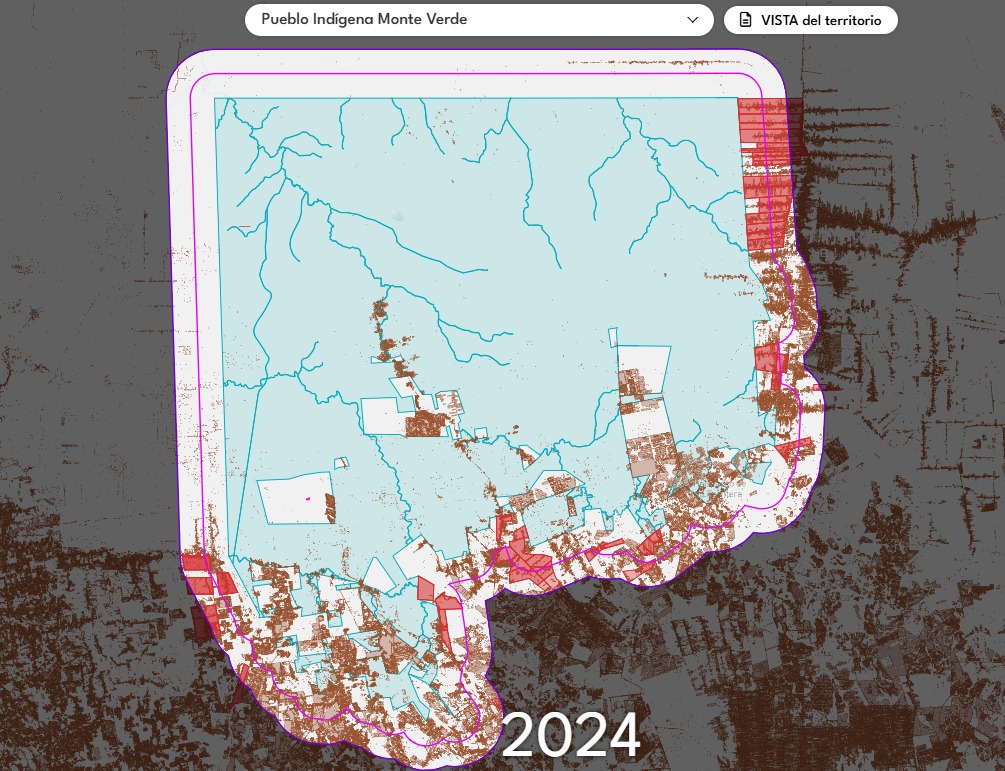
While much of this territorial demand remains unresolved, the State has continued allocating land to third parties in areas bordering Indigenous territories.
While much of this territorial demand remains unresolved, the State has continued allocating land to third parties in areas bordering Indigenous territories.
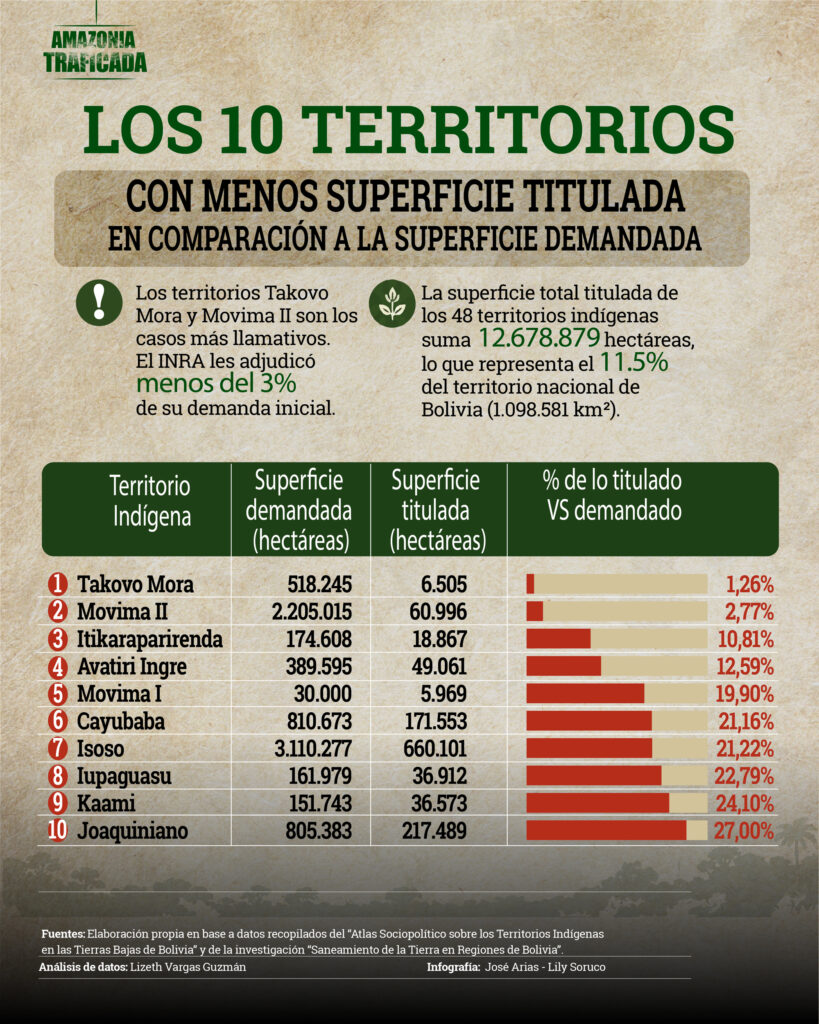
From the 1990s through the first decades of the twenty-first century, the 48 Indigenous territories in the Amazon basin collectively requested legal recognition of around 22.7 million hectares. Yet the National Institute for Agrarian Reform (INRA) titled only 11.7 million hectares—just 52% of the area claimed. In other words, more than 11 million hectares were left outside the titling process.
While much of this territorial demand remains unresolved, the State has continued allocating land to third parties in areas bordering Indigenous territories. Between 2009 and 2019, INRA allocated approximately 318,500 hectares for the establishment of 236 intercultural and campesino communities, whose social organizations were aligned with the political party that governed Bolivia between 2006 and 2025.
When Protection Is Not Enough
The gap between the protection the State says it provides and what actually happens within Indigenous territories also appears in the Seventh National Report itself. Bolivia acknowledges that it lacks information to measure, amongst other things, land tenure in the ancestral territories of Indigenous Peoples and local communities. It also acknowledges problems of land grabbing and illegal tenure.
These ancestral peoples face pressure from third-party communities settled around their titled territories with authorization from the National Institute for Agrarian Reform. But they also face land grabbing within areas legally recognized by the State—that is, territories for which they hold collective title.
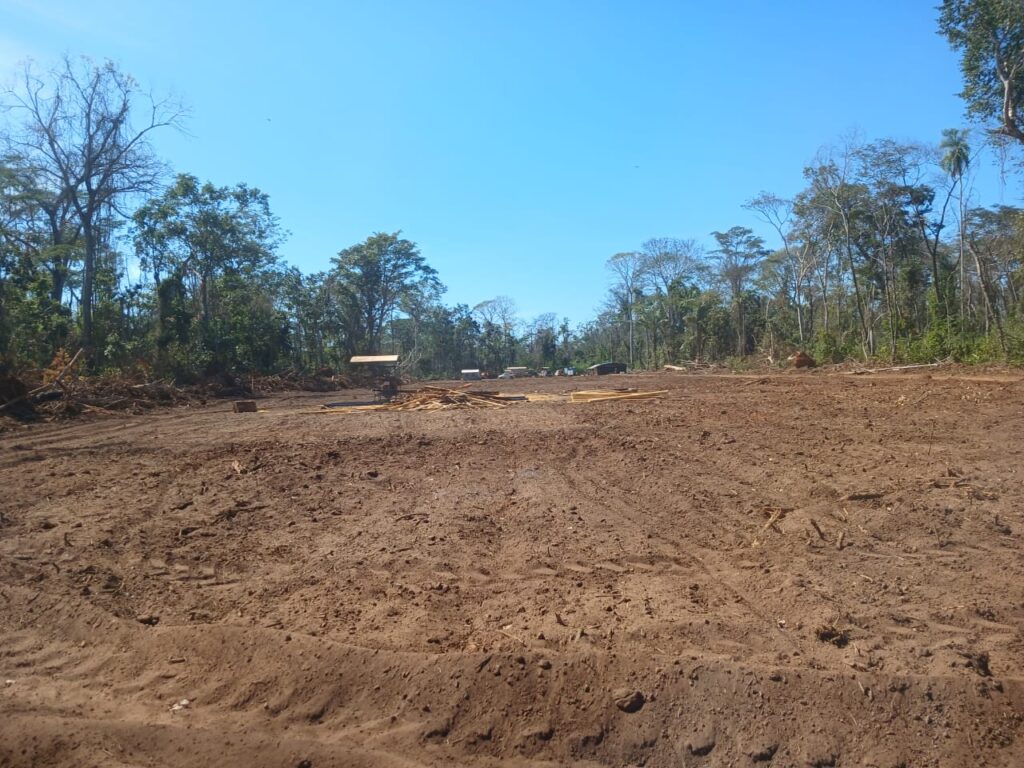
While Indigenous communities denounce land grabbing and State institutions take months—even years—to act, the trees keep falling and Indigenous territories keep being trafficked.
While Indigenous communities denounce land grabbing and State institutions take months—even years—to act, the trees keep falling and Indigenous territories keep being trafficked.
An analysis of interviews with leaders from 30 of the 48 titled Indigenous territories in the Amazon basin concludes that 28 of these ancestral territories have experienced land grabbing over the past two decades and that, in 22 cases, the conflicts remain unresolved. According to the leaders interviewed, behind these occupations are networks seeking to fuel an illicit land market in the Bolivian Amazon, primarily to open up land for large-scale agricultural activities.
While Indigenous communities denounce land grabbing and State institutions take months—even years—to act, the trees keep falling and Indigenous territories keep being trafficked. But this is not the only pressure. The 30 Indigenous leaders also identified conflicts and threats linked to carbon markets, illegal mining, timber trafficking, and drug trafficking.
Conserving Beyond the Map
In Yerevan, Bolivia will have to show how much progress it has made toward 30×30. It will be able to talk about titled territories, Indigenous governance, and conservation under Indigenous management. Yet behind those figures are territories where trees continue to fall, where disputes over land persist, and where Indigenous communities wait years for the State to respond to land grabbing and the trafficking of their lands.
30×30 may look achievable when viewed on a map. But conservation does not happen on a map. It happens in real territories, where Indigenous Peoples defend their forests, their rights, and their ways of life. The unresolved issue Bolivia will take to COP17 is not simply how many hectares it can declare conserved, but how much of what it says it protects is actually safe—and how effectively it can halt or control the pressures it acknowledges in its own Seventh National Report: the expansion of the agricultural frontier, extractive activities, and human settlements as major drivers of biodiversity loss and deforestation.
In other words, beyond the exam it must sit in October, the Bolivian State—regardless of who happens to be the current occupant of power in La Paz—must be capable of enforcing the rules it has created and guaranteeing the protection of the forests and of those who inhabit these ancestral lands. This is not only an obligation to Bolivians. It is also a responsibility to a planet that no longer has time to wait for promises to become action.
Nelfi Fernandez Reyes is an investigative journalist specializing in digital storytelling. She is a member of the International Consortium of Investigative Journalists (ICIJ) and the Connectas Hub, through which she has coordinated collaboration in Bolivia for high-impact cross-border investigations including the Panama Papers, FinCEN Files, and Pandora Papers.