
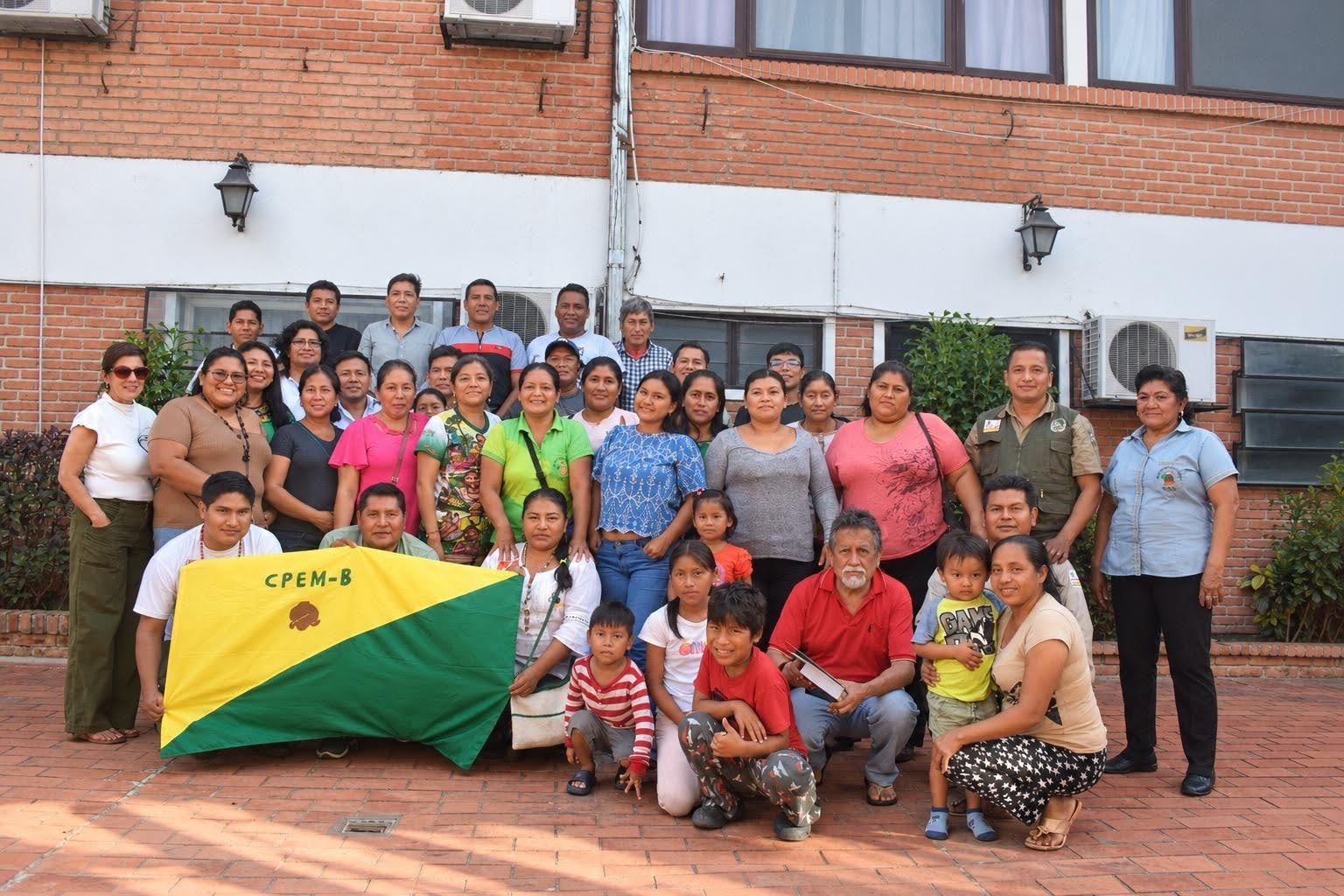
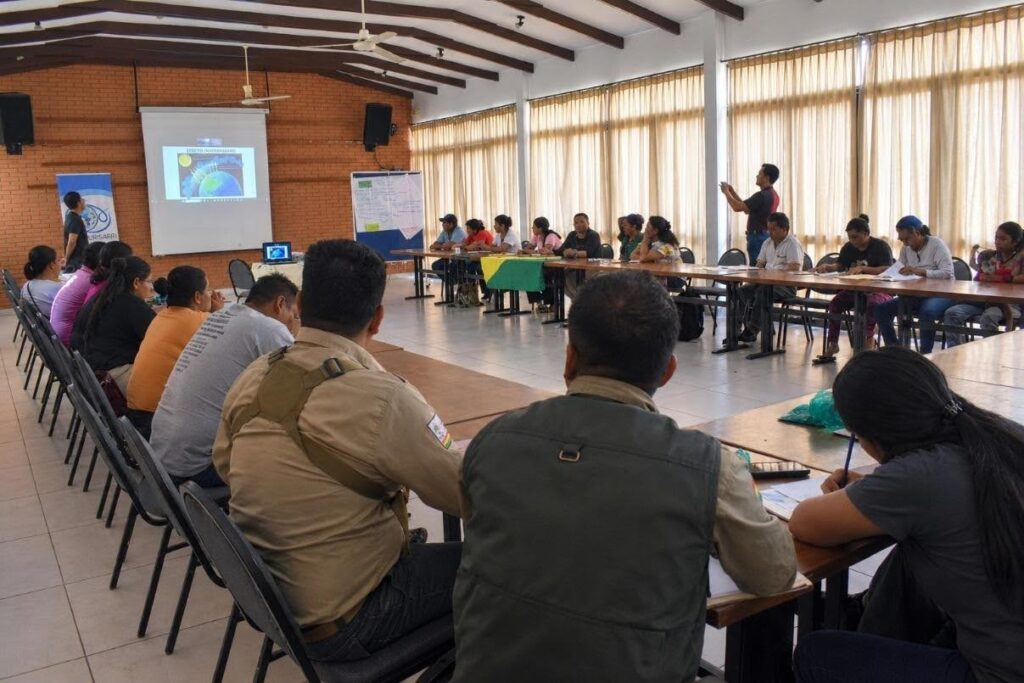
The International Interorganisational Meeting of Indigenous Peoples of the Amazon Basin took place in Santa Cruz de la Sierra from September 25th and 26th, 2026. Discussions among Indigenous territorial representatives, national experts, and international specialists revealed tensions within Indigenous communities and external pressures on their territories and protected areas. Against this backdrop, the social and political debate surrounding climate finance and carbon markets is intensifying in the Plurinational State of Bolivia.
Since 2012, the Plurinational State of Bolivia has opposed the commodification of nature’s environmental functions, as established in Framework Law No. 300 on Mother Earth and Integral Development for Living Well: “All plans and programmes aimed at reducing greenhouse gas (GHG) emissions shall focus on the non-commodification of the environmental functions of the components of Mother Earth and shall therefore exclude financing mechanisms linked to carbon markets.” This prohibition prevented carbon credit promoters from entering the country with promises of substantial financial resources, development, and progress for rural communities.
A decade later, under the government of Luis Arce Catacora, Plurinational Constitutional Court Ruling No. 0040/2024 declared the prohibition on the commodification of environmental functions unconstitutional, ordering the removal of the relevant provisions of Law No. 300 from the legal framework. The Court justified its decision by arguing that the prohibition conflicted with a number of international agreements and rights, including the primacy of international treaties (such as the Paris Agreement and the Kyoto Protocol), the right to trade, freedom of enterprise, and the right to a healthy environment. However, the ruling failed to establish minimum guarantees or safeguards to protect Indigenous Peoples’ rights and territorial rights.
The removal of the prohibition paved the way for carbon markets in Bolivia, allowing access to international climate finance mechanisms. Against this backdrop, the government of Luis Arce Catacora issued Supreme Decree No. 5264, establishing guidelines for the management of and access to climate finance. These included the creation of the National Registry of Programmes and Projects (RENAPP), the introduction of Emission Reduction Units, and provisions defining the State’s role in channelling climate finance.
Private Interests in Indigenous Territories
State efforts to regulate carbon markets are advancing along two parallel tracks. On the one hand, the Chamber of Deputies is promoting Bill No. 060/2025–2026, on the Regulation of the Market for Greenhouse Gas Emission Credits and Allowances. On the other, the Vice-Ministry of Environment, Biodiversity, Climate Change, and Forest Management and Development is drafting the Framework Bill on the Regulation and Coordination of Climate and Biodiversity Finance. While the Framework Bill remains in the early stages of development, the Carbon Markets Bill is already set to be debated by the full Chamber of Deputies. This haste highlights a lack of planning and coordination.
Although both state bodies have held information-sharing sessions with the Confederation of Indigenous Peoples of Eastern Bolivia (CIDOB), Indigenous organisations have repeatedly called for compliance with international standards and respect for their own rules and procedures before any legislative debate takes place. Nevertheless, given the State’s institutional track record, there are concerns that it will bypass the requirement for Free, Prior and Informed Consultation in accordance with Indigenous Peoples’ own rules and procedures, thereby violating their constitutional and collective rights.
Indigenous Peoples of the Lowlands, whose territories cover vast areas of land, now face the imminent risk of being subjected to decisions driven by party-political interests and the agro-industrial sector’s pursuit of capital accumulation.
Indigenous Peoples of the Lowlands, whose territories cover vast areas of land, now face the imminent risk of being subjected to decisions driven by party-political interests and the agro-industrial sector’s pursuit of capital accumulation.
The bills promoted by the Government and business interests seek to generate profits in the name of Indigenous Peoples and the Amazon. In this regard, David Quiroga, President of the Coordinating Body of Indigenous Peoples of the Tropics of Cochabamba (CPITCO), states: “The national Government, through its ministers and those around them, sees carbon credits as a business opportunity. Incredibly, government officials themselves are setting up their own NGOs, foundations and intermediary organisations because they see an opportunity to make money. They want to profit in the name of Indigenous Peoples, the Amazon, and our forests. I find this unacceptable.”
Indigenous Peoples of the Lowlands, whose territories cover vast areas of land, now face the imminent risk of being subjected to decisions driven by party-political interests and the agro-industrial sector’s pursuit of capital accumulation. In this regard, Manuel Gonzales of CIDOB warned: “As Indigenous Peoples, we are up against political forces, private businesses and the Government, and we often find ourselves alone. We need allies to confront this struggle, because it could turn into a full-scale dispute over our territories.”
Failed Carbon Credit Initiatives and the Lack of Transparency
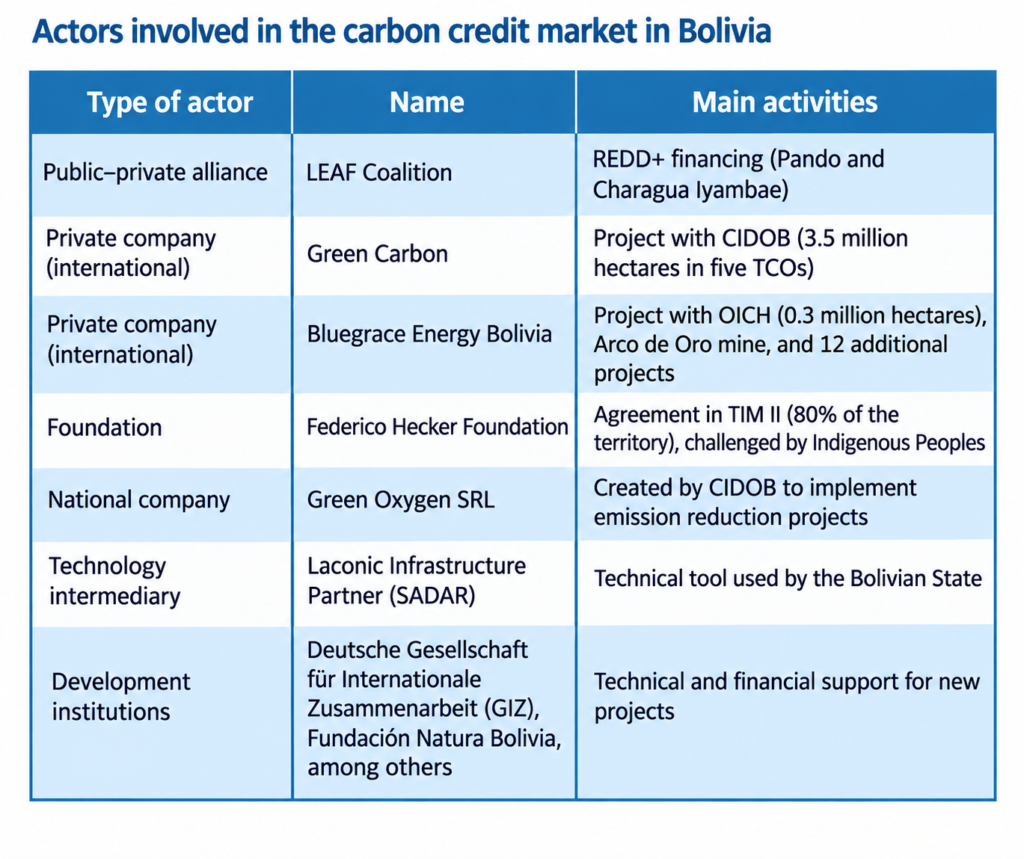
Experts have identified a wide range of actors involved, highlighting the participation of national and international private companies, state institutions, intermediary organisations and multilateral partnerships: the LEAF Coalition, Green Carbon, Bluegrace Energy Bolivia, the Federico Hecker Foundation, Green Oxygen SRL, Laconic Infrastructure Partners (SADAR), Deutsche Gesellschaft für Internationale Zusammenarbeit (GIZ) and the Natura Bolivia Foundation.
These organisations play strategic roles in the development of carbon credit projects, including the design, financing, implementation, and management of initiatives aimed at mitigating, reducing, or removing greenhouse gas emissions. In practice, however, the implementation of carbon projects in Bolivia has led only to frustration and a lack of transparency. Expert Miguel Vargas recalled that the pilot project in Noel Kempff Mercado National Park, managed by the Fundación Amigos de la Naturaleza (FAN) and The Nature Conservancy (TNC), failed to secure the sale of carbon credits due to “the lack of a government signature and regulatory gaps”.
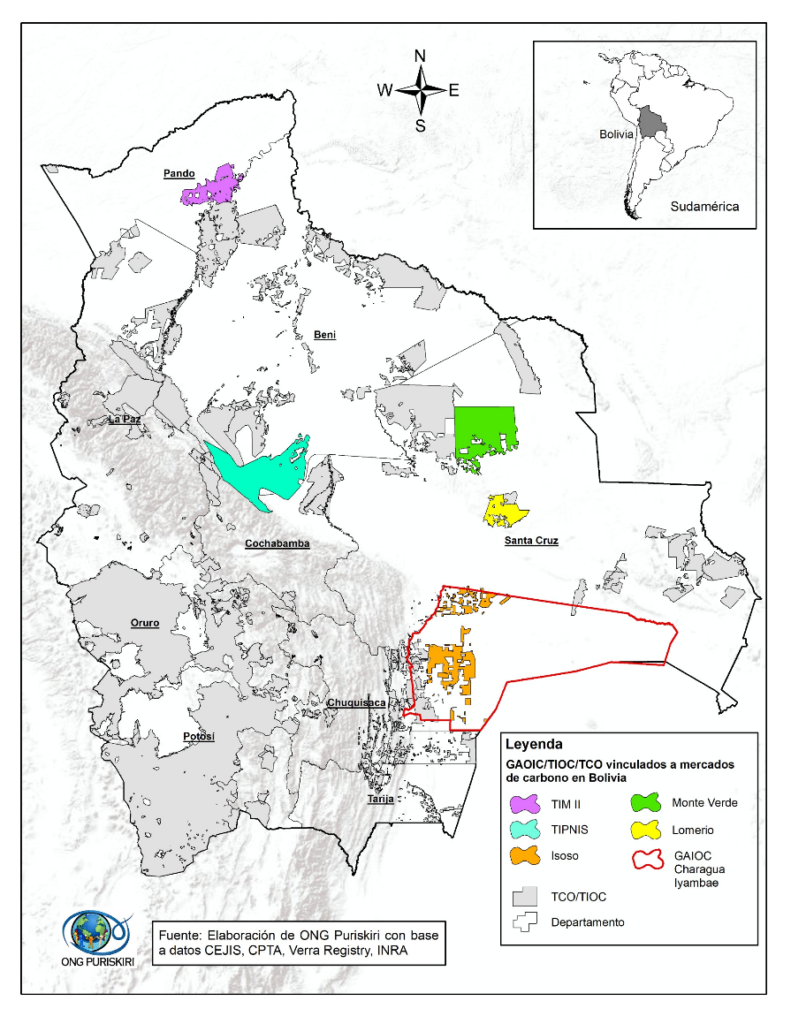
Regarding the lack of transparency in contractual arrangements, researcher Stasiek Czaplicki points to several private projects promoted by intermediary companies, such as Green Carbon, in Indigenous territories across Bolivia. These include the Isiboro Sécure Indigenous Territory and National Park (TIPNIS), the Monte Verde Indigenous Community Land, the Multiethnic Indigenous Territory (TIM II), Isoso and Lomerío, with contracts spanning 35 to 100 years. These agreements involve the full transfer of carbon rights and submission to private commercial arbitration bodies, such as the Chamber of Industry, Commerce, Services, and Tourism of Santa Cruz (CAINCO). Furthermore, the lack of information available to communities undermines their right to self-government and self-determination in decisions concerning their territories.
Finally, the bills driven by business interests seek to circumvent social consensus and strict compliance with constitutional and international standards on Free, Prior, and Informed Consultation (FPIC). Francisco Maza, of the Central de Pueblos Étnicos Mojeños del Beni (CPEM-B), stressed the need to address both consultation and consent: “We must work on free, prior and informed consultation, including consent, and on planning from within our own territories. We have to be part of this entire process. This mechanism is going to be implemented, but the question is: where do we stand? We cannot simply wait until everything has been approved before making our voices heard.”
Contradictions in Bolivia’s Legal Framework
The debate over the unviability of carbon credits in Bolivia persists due to structural risks and vulnerabilities associated with the country’s legal framework. These include the so-called “fire laws”, Nos. 337, 741 and 1171, which facilitate burning and place pressure on forests and Indigenous territories without imposing significant penalties. Between 2016 and 2025, nearly 50 million hectares of land were burned in Bolivia, highlighting the persistence of this environmental and territorial problem. The scale of these fires has made Bolivia the country with the second-largest burned area in Latin America.
In this regard, Czaplicki explains: “First, there must be a functioning national forest management programme that serves as the primary source of funding, with carbon credits playing a complementary role. Second, there must be genuine disincentives to deforestation. This means that penalties must be high enough to ensure that deforestation is no longer profitable, even when fines are imposed. Third, there must be a comprehensive and effective fire management strategy focused on prevention and firefighting. Unless these conditions are met, it will be very difficult for carbon projects to function researcher Cassandra Smithies emphasises: “Companies pay to gain access to forests, obtain their carbon credits and continue polluting.properly, as shortcomings remain in all three areas.”
Researcher Cassandra Smithies emphasises: “Companies pay to gain access to forests, obtain their carbon credits and continue polluting”.
Researcher Cassandra Smithies emphasises: “Companies pay to gain access to forests, obtain their carbon credits and continue polluting”.
This contradiction between the legal framework and the State’s institutional weaknesses is compounded by the economic paradox of carbon markets. The sale of carbon credits would finance the conservation of forests and Indigenous territories by selling emission rights to highly polluting transnational corporations, such as oil, mining, and logging companies. In this way, large corporations are able to shift their environmental responsibility onto the Global South, including Indigenous Peoples who protect their territories.
On this point, researcher Cassandra Smithies emphasises: “Companies pay to gain access to forests, obtain their carbon credits and continue polluting. The key is to understand that carbon markets can lead to territorial dispossession and constitute a false solution to climate change, as companies continue exploiting resources and polluting.” Smithies therefore stresses the importance of asking: “Who is behind REDD? Who is promoting the REDD mechanism, carbon markets and these false solutions? The very same oil, mining and logging companies, alongside some conservation NGOs that ultimately facilitate the interests of extractive industries.”
Warnings, Threats and Concerns Regarding Carbon Market Regulation
Over the past six months, various national and international actors have pursued strategies aimed at promoting legal certainty, attracting investment, and facilitating access to climate finance mechanisms and carbon markets. The central government, departmental governments in eastern Bolivia (Pando, Beni and Santa Cruz), the business sector and conservation NGOs have used a range of communication channels, including social media, official communications and alternative media, to shape public perceptions of the “opportunities” offered by green economy projects.
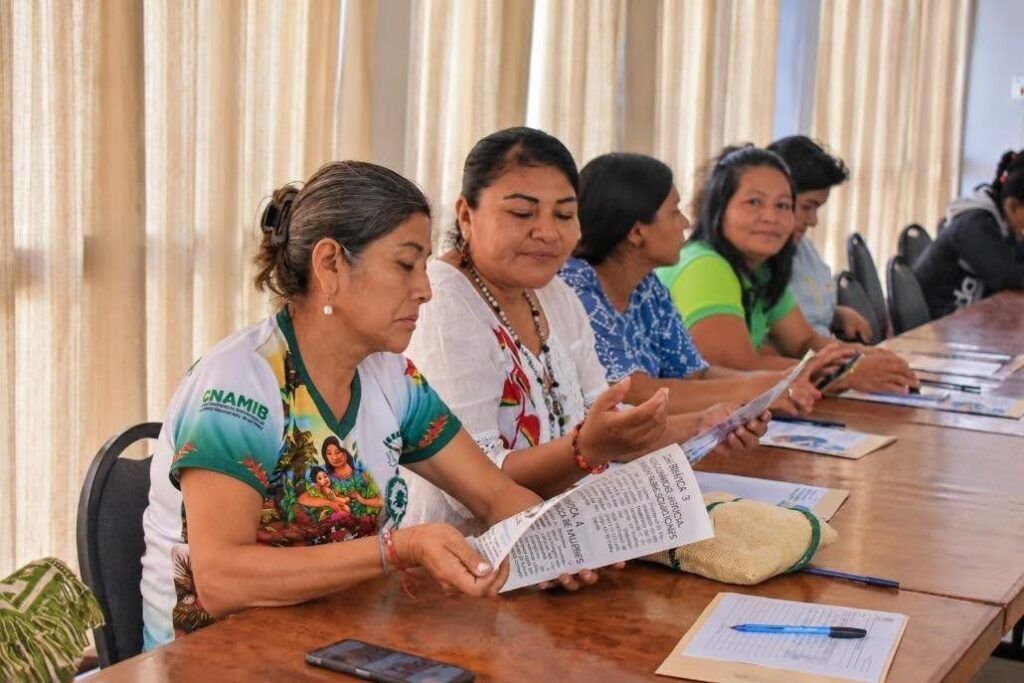
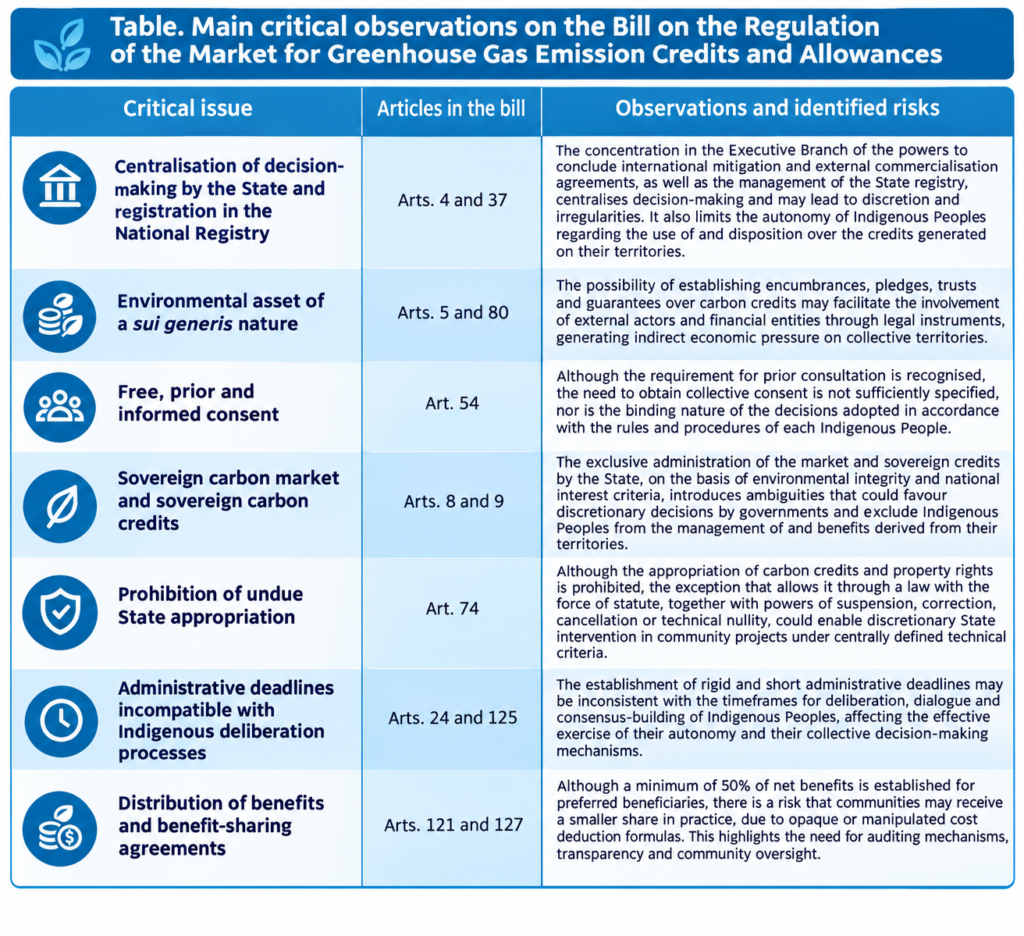
However, even as concerns grow over these promises, the proposed Regulation of the Market for Greenhouse Gas Emission Credits and Allowances raises several fundamental concerns. During the International Interorganisational Meeting of Indigenous Peoples on the Climate Crisis and Climate Finance, following extensive reflection and debate on experiences in Ecuador, Peru, and Bolivia, participants identified a number of preliminary warnings and threats:
- Lack of transparency and the imposition of state and corporate interests in the development of failed carbon credit projects.
- Absence of Free, Prior, and Informed Consultation (FPIC), with government authorities and intermediaries passing off mere information-sharing activities as genuine consultation processes.
- Territorial fragmentation and the co-option of local actors by intermediaries promoting carbon markets in Indigenous territories.
- Pressure from external actors seeking to benefit from carbon projects, creating divisions and parallel organisational structures that weaken social cohesion and territorial governance.
- Economic disparities and mistrust of intermediaries and the distribution of revenue generated by carbon credits, as most of the proceeds remain within the state bureaucracy or in the hands of intermediaries.
- Abusive contractual arrangements imposed by intermediary companies through opaque, long-term agreements (30 to 100 years), posing risks of territorial dispossession or the transfer of rights that could restrict territorial self-government.
- Weaknesses within some national and regional Indigenous organisational structures due to political party and government interference, prompting calls to revise their statutes to protect organisations from unfavourable carbon credit projects.
Consequently, during the meeting, Indigenous organisations, together with local and international specialists, proposed the following measures to ensure that decisions are made autonomously, on the basis of adequate information and without harming their territories:
- Indigenous organisations consider it urgent to establish their own Free, Prior, and Informed Consultation and Consent protocols, tailored to each Indigenous People, to define territorial rules before entering into any negotiations.
- All public and private initiatives must disclose their gross costs, benefit-sharing plans, and voluntary withdrawal clauses. Forest conservation in Bolivia must not become a means of undermining Indigenous Peoples’ self-government and self-determination.
- Carbon credits must not be presented as an economic lifeline that creates false expectations, but rather as a contested arena in which territorial sovereignty is at stake.
- Indigenous Peoples agree on the need to defend self-government, binding Free, Prior and Informed Consultation and direct control over resources to prevent carbon markets from becoming a new form of green neo-extractivism and territorial dispossession.
- The need to strengthen legal self-defence mechanisms and develop proposals establishing non-negotiable minimum requirements to safeguard Indigenous Peoples’ self-government and self-determination.

Sergio Vasquez Rojas is the Executive Director of the NGO PURISKIRI and a lawyer specialising in agricultural and environmental law, Indigenous law and territorial management.