
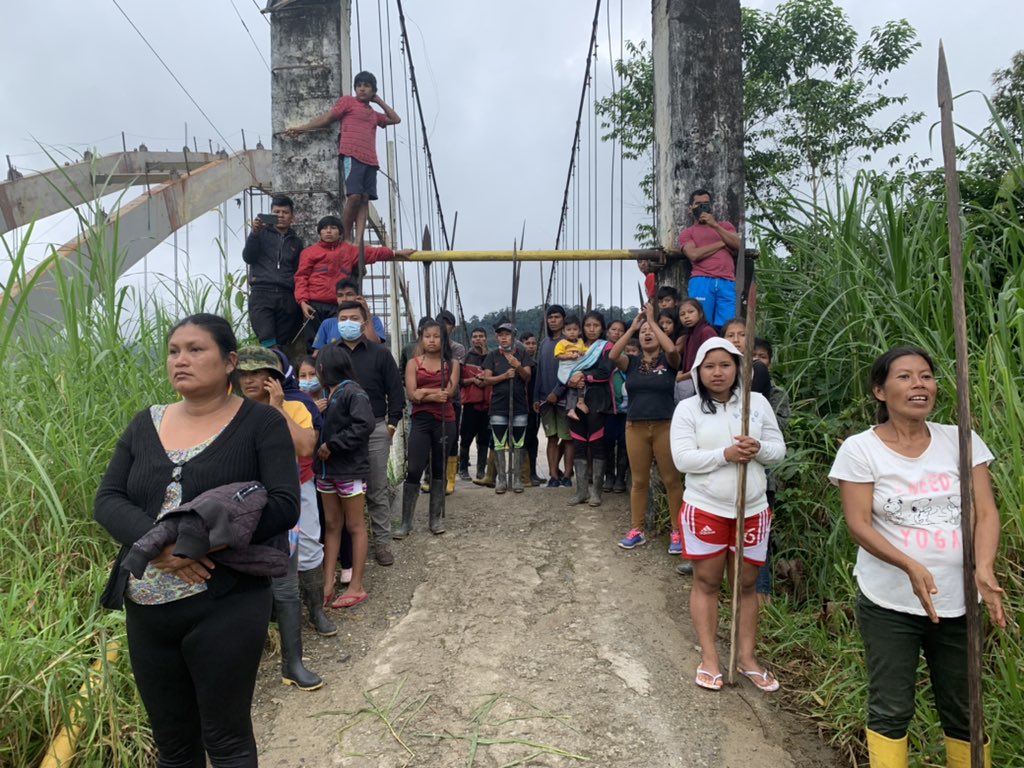
The expansion of illegal mining in Ecuador is alarming. Since 2020, mining activity has doubled in the country. In the absence of action from a neoliberal government, environmental damage is being inflicted on areas that are rich in biodiversity and highly fragile while the presence of armed groups grows along with the criminalization of Indigenous leaders and environmental defenders. Due to the State’s complicity, transnational companies extract wealth, leaving only liabilities in Indigenous territories. Water contamination with mercury and the degradation of topography from the indiscriminate use of explosives and heavy machinery in the rivers have become widespread problems.
Ecuador, a country of just 270,670 square kilometers located in the heart of South America, is home to over 17 million inhabitants, 1.5 million of whom are Indigenous peoples and nationalities. Most of these populations are distributed across the Andean mountains, but also throughout the six Amazonian provinces and along the coastline, particularly in the northern region.
The territories of the Indigenous Peoples of Ecuador are characterized by their rich biodiversity and, simultaneously for containing significant subsurface resources such as hydrocarbons and metallic and non-metallic minerals. The extraction of these resources has been the core of the country’s primary export-oriented economic model for the past five decades. This means that the economy is anchored to the dynamics of the global commodities markets, particularly oil, gold, and copper.
The mineral market is controlled by transnational corporations that sign highly favorable contracts for foreign investors. With 80% of Andean mining under the control of companies from Canada, the United States, China, South Africa, and Switzerland, how much of this wealth truly stays at home? The extraction of metallic minerals (such as gold, copper, and silver) is prioritized as an engine of economic growth, but at high socio-environmental cost in the form of violations of Indigenous rights, damage to their territory, and the displacement of communities. Furthermore, the volatility of international prices encourages cycles of overexploitation during booms and crises during downturns.
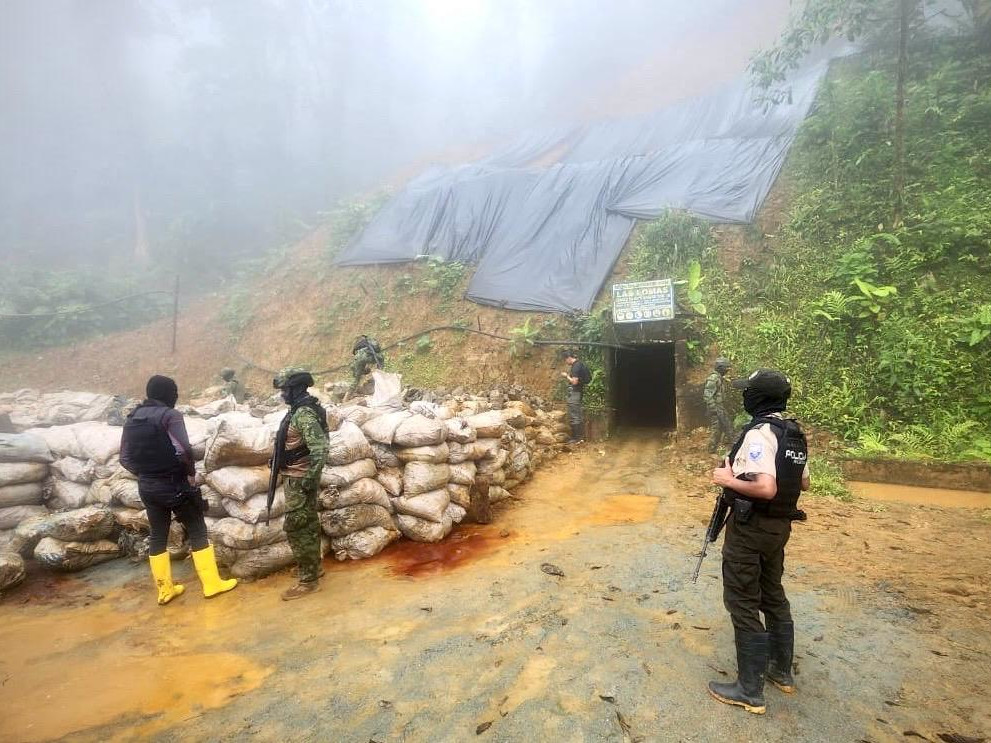
An unstoppable advance
In this context, Ecuador’s dollarized economy, with a state dependent on revenue from extractive activities, has sought to diversify its production matrix and reduce its reliance on oil exports over the past decade. In this framework, the expansion of mining has created some opportunities for formal and legal investment. However, it has also led to two, major harmful effects; the rise of illegal mining and an increase in socio-environmental conflicts, accompanied by the violation of collective rights and damage to the territories of Indigenous Peoples.
According to Ecuador’s Ministry of Energy and Mines, the mining sector directly employs over 20,000 people and indirectly employs nearly 100,000. Between 1985 and 2023, both legal and illegal mining covered 13,000 hectares nationwide. In recent years, that coverage has expanded at a rate of 2,600 hectares per year, representing 35% of the total area reached in the last 35 years.
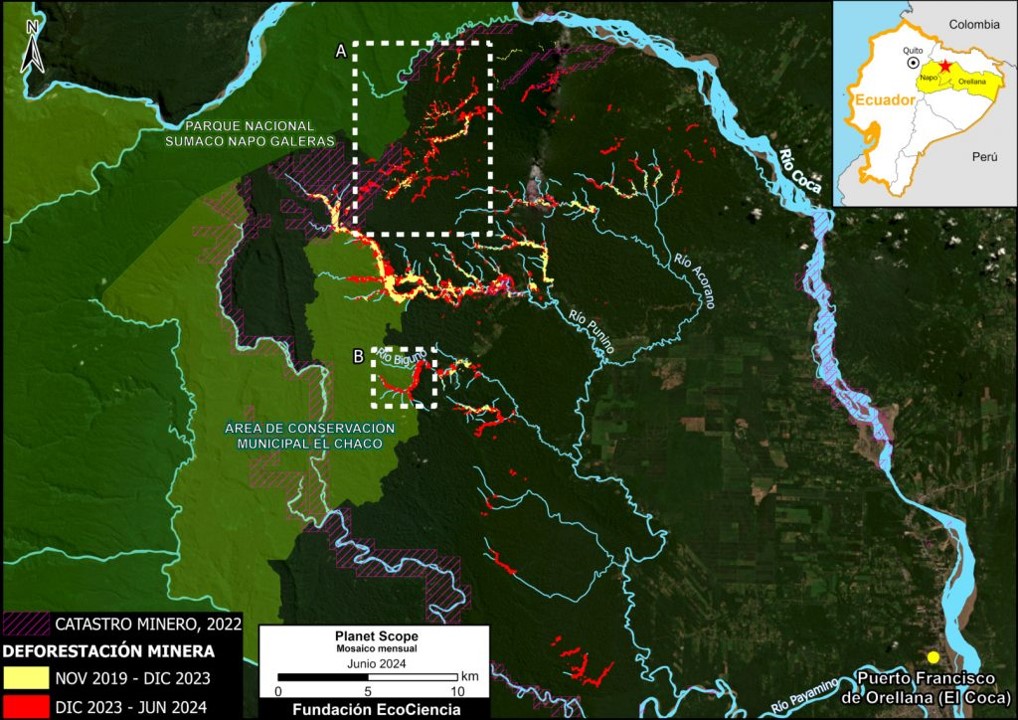
Illegal mining in the central Amazon, particularly in Napo, has expanded by 500 hectares in just one year. Throughout the Ecuadorian Amazon region, it is estimated that 7,490 hectares have been affected by illegal mining, especially gold mining.
Throughout the Ecuadorian Amazon region, it is estimated that 7,490 hectares have been affected by illegal mining, especially gold mining.
Seventy percent of the expansion is concentrated in the Amazon, where open-pit mining projects such as Cóndor Mirador (in the exploitation phase) and Warintza (in the exploration phase) are operating. According to the Ecociencia Foundation, illegal mining in the central Amazon, particularly in Napo, has expanded by 500 hectares in just one year. Throughout the Ecuadorian Amazon region, it is estimated that 7,490 hectares have been affected by illegal mining, especially gold mining.
According to data from the Ministry of the Environment, illegal mining has affected 562 hectares in four protected areas of this region: the Cofán Bermejo Reserve, the Sumaco-Napo Galeras National Park, the El Zarza Wildlife Refuge, and the Podocarpus National Park. Illegal mining also impacts territories in the Andes, in the provinces of Bolívar, Azuay, and Imbabura, as well as Indigenous territories and Afro-Ecuadorian communities in the province of Esmeraldas.
Mining and organized crime in Napo
The territory of the province of Napo is the ancestral home of the Quijos and Napo Runa, as well as the Waorani. During the 19th and 20th centuries, at least two major waves of settlers partially occupied their lands, known for their great biodiversity and various ecological zones. In this region, indigenous communities have developed community-based forestry enterprise, organic cacao and chonta production in Rukullacta, along with a community tourism network managed by the Federation of Indigenous Organizations of Napo (FOIN).
However, everything was significantly disrupted due with the arrival of both legal and illegal mining. Mining activity has increased by 300% since 2015. Between 2015 and 2021, areas with mining activity increased by 855 hectares, according to data from the Monitoring of the Andes Amazon Program (MAAP) and the Ecociencia Foundation. The problem became even more severe between 2022 and 2024, when mining expansion in the cantons of Carlos Julio Arosemena Tola and Tena doubled, growing from 1,118 to 2,024 hectares. The environmental impact is evident. Between 2019 and 2021, mining-related deforestation wiped out 32 hectares of forest, while in 2022, the losses amounted to 185 hectares. Moreover, mining activity has increased by 300% since 2015.
Mining in Napo has fueled an organized crime structure comparable to drug trafficking.
Paradoxically, at the beginning of 2022, Napo had 142 gold and aggregate concessions, yet none met the requirements to operate legally. Of these, 62 were suspended, 45 had lost their exploitation rights, and 35 were still under review. In other words, as of March 18 of that year, all mining activity in the province was illegal.
In this context, mining in Napo has fueled an organized crime structure comparable to drug trafficking. It is estimated that, in six key areas (Ahuano, CIAT, Río Punino, Río Jatun Yaku, Puninos, and Río Anzú), between 150,000 and 230,000 grams of 18-karat gold are extracted daily — generating revenues of $8 to $11 million per day. The rise in illegal mining has escalated social conflicts, with community leaders and activists reporting threats and attacks.
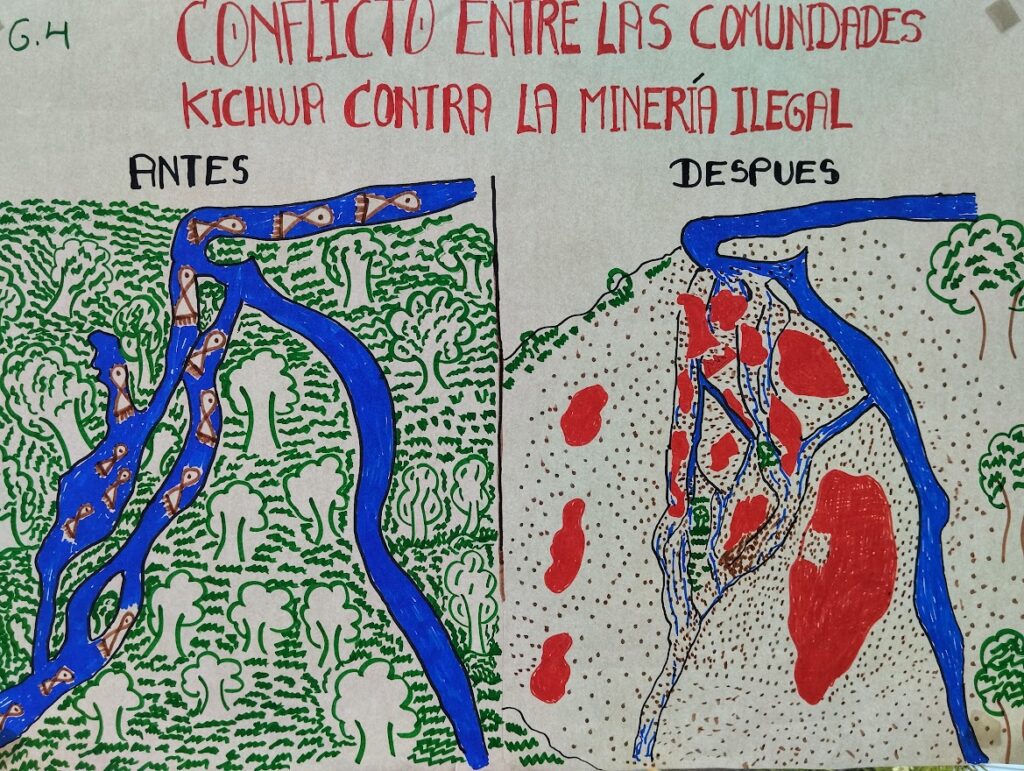
The growing tension in Las Naves
The mining conflict in Las Naves canton, located in the Central Highlands, has intensified due to the expansion of mining in the region. A key turning point occurred in 1993, when the local population expelled the British company Río Tinto from the province, setting a precedent for civil resistance against extractivism. In 2003, the Las Naves mining concession was granted to a private entity which later transferred the rights to Amlatminas and subsequently to Curimining, a subsidiary of the Canadian company Salazar Resources Ltd.
Despite public opposition the Ministry of the Environment approved the advanced exploration phase in 2015 without prior consultation with the community. In 2021, Guillermo Lasso’s government promoted mining activities through Executive Decree 151, facilitating the exploitation of projects classified as strategic. This decision created the conditions for the conflict to escalate in October 2021, when a “march for peace” organized by groups aligned with Curimining resulted in violence and social division.
The case of Las Naves reflects the escalating tension between mining expansion and the defense of territory. The community now plans to appeal to international bodies in search of justice.
A year later, the government signed a $292 million contract with foreign mining companies to exploit the deposit. In June 2023, the Ministry of the Environment announced an environmental consultation on the Environmental Impact Study, but rural communities denounced that it was conducted without democratic guarantees. The consultation included only seven communities within the area of influence, excluding ten others that rely on the region’s water sources. In response, the community organized a protest on July 14 that was met with tear gas, resulting in 13 people injured and two detained.
By August 2023, the detainees were prosecuted for damage to public property, facing a trial without due process. The criminalization of land defenders continued into 2024, with more arrests and legal proceedings. This past June, the communities of Buenos Aires, Bellavista, and Jerusalén filed a protection action against the Ministry of the Environment, but it was rejected. The case of Las Naves reflects the escalating tension between mining expansion and the defense of territory. The community now plans to appeal to international bodies in search of justice.

The Cofán Bermejo Ecological Reserve Case
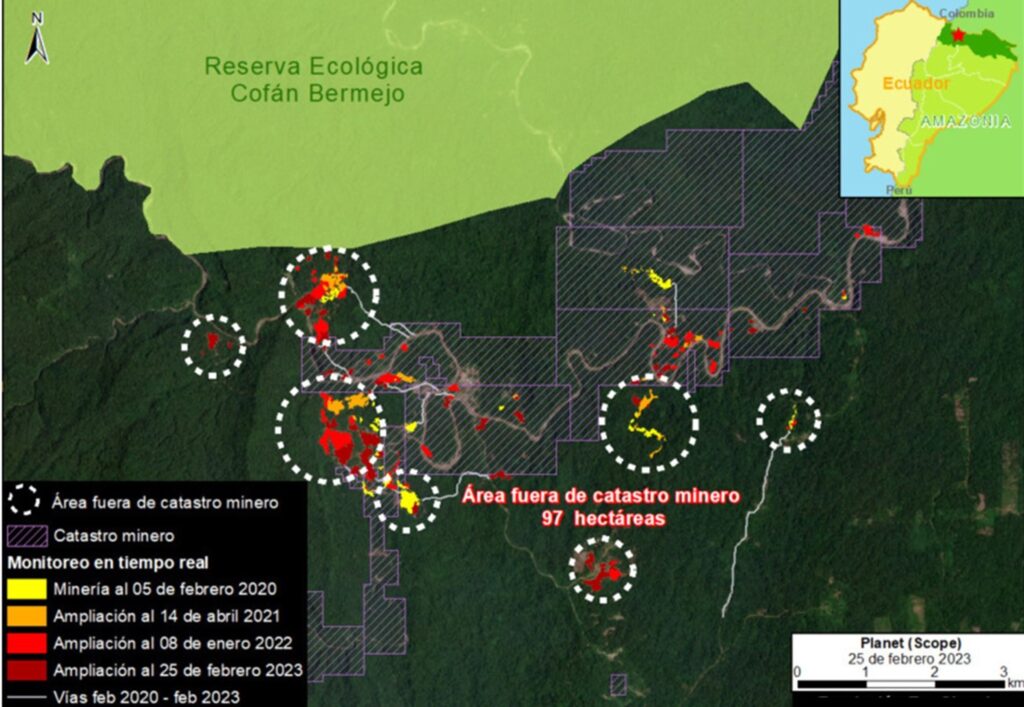
The Cofán Bermejo Ecological Reserve spans 55,451 hectares along the border with Colombia. With its dense tropical forest cover, this protected area is one of the most important biodiversity sanctuaries in Ecuador and is home to the A’i Cofán people. Families share the land with howler monkeys, coatis, anteaters, jaguars, pumas, and ocelots. For over 40 years, the A’i Cofán have faced repeated threats to their territory: oil projects, illegal logging, and invasions by settlers and land traffickers.
More recently, mining activities have emerged as an additional danger. The Andean Amazon Monitoring Project identified 337 hectares affected by illegal mining in the reserve’s buffer zone. Of that total, at least 1.05 hectares lie within the protected area’s boundaries — a direct threat to the ecosystem’s integrity. Heavy machinery tears through the forest, creating massive craters and pools for gold extraction, leaving behind polluted water and widespread destruction.
Several leaders have received threats for monitoring illegal activities, while fear of reprisals silences those who dare to speak out.
Greed for resources has fueled the rise of armed groups in the region, particularly in Barranca Bermeja. With no state presence, the Comandos de Frontera — a dissident faction of the FARC — assert control, demanding identification from residents. Beyond illegal mining, other illicit activities such as drug trafficking, fuel smuggling, and human trafficking loom over this border region. Far from offering relief, the pandemic accelerated the expansion of illegal mining, especially in the buffer zone.
Shuar communities, like Taruka and Etsa, have implemented internal controls to regulate activity on their lands. The reserve, created by the A’i Cofán people to safeguard their ancestral territory, now stands at a breaking point. Several leaders have received threats for monitoring illegal activities, while fear of reprisals silences those who dare to speak out. The park rangers — barely a dozen tasked with protecting the entire reserve — face constant danger and have also received threats after conducting operations against illegal mining.
Human Rights and Conflict: A Darkening Future
More than an environmental issue, mining has become a tangled web of corruption and organized crime, involving business people, police, and public officials. Carlos Mazabanda from Amazon Frontlines warns that legal mining concessions have served as a front for illegal operations, while investigative reports have uncovered shady contracts enabling their expansion. Furthermore, data from Ecuador’s Central Bank and records from China reveal a multi-million-dollar discrepancy in gold exports — suggesting the existence of a money laundering network.
Mazabanda points out that President Daniel Noboa’s declaration of an internal armed conflict overlooks how illegal mining fuels criminal groups. According to Amazon Watch, gold trade has now become the most dominant form of organized crime in the Ecuadorian Amazon. Drug trafficking networks have turned to illegal mining as a profitable tool for laundering money, driving increases in violence, extortion, and the smuggling of mercury, weapons, and drugs. In provinces such as El Oro, Azuay, Imbabura, Napo, and Zamora Chinchipe, gangs like Los Lobos have seized control of mining operations.
Shell companies, established under the Simplified Joint Stock Company (SAS) framework, became a vehicle for money laundering, enabling unlicensed exporters to operate without restriction.
Despite the Mining Regulation and Control Agency suspending mining registrations in 2018, over 650 concessions were granted between 2019 and 2024.
The rise of small-scale or artisanal gold mining is undeniable. In 2023, exports surpassed $1.26 billion, even exceeding the country’s only formal mining company. This boom, however, has come alongside the expansion of organized crime. Between 2019 and 2023, homicide rates quintupled, with Indigenous communities bearing the brunt of the violence. Despite the Mining Regulation and Control Agency (ARCOM) suspending mining registrations in 2018, over 650 concessions were granted between 2019 and 2024. At least 15 companies and 18 individuals have profited from illegal gold extraction, aided by complicit regulators.
Fernando Benalcázar, former Vice Minister of Mining, highlights that ARCOM’s dissolution in 2020 triggered total disorder. Shell companies, established under the Simplified Joint Stock Company (SAS) framework, became a vehicle for money laundering, enabling unlicensed exporters to operate without restriction. Meanwhile, agencies like the Internal Revenue Service (SRI) and the Financial Analysis Unit (UAFE) have failed to track the origin of the vast sums flowing through this multi-billion-dollar industry. In August 2024, the government reinstated ARCOM — but the lingering question is whether it will be enough to rein in an industry where organized crime has become deeply entrenched.
Pablo Ortiz-T. is a sociologist and holds a PhD in Cultural Studies. He coordinates the State and Development Research Group (GIEDE) at the Universidad Politécnica Salesiana, Quito campus, and is an associate researcher at IWGIA. Contact: portiz@ups.edu.ec