
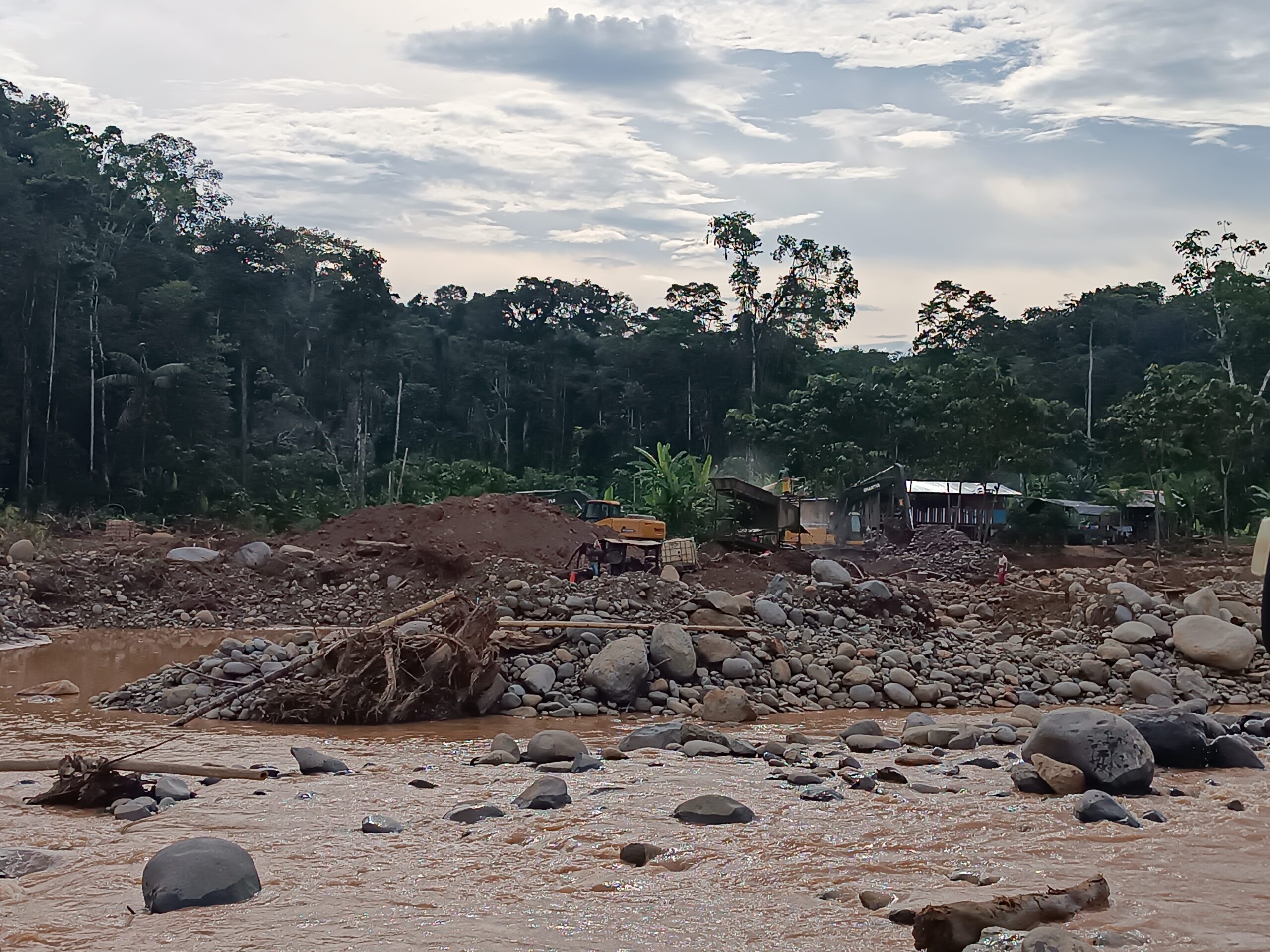
Over the past decade, the expansion of drug trafficking and mining has had a profound and devastating impact on Indigenous territories. Although the 2008 Constitution strengthened collective rights and guarantees, the State has remained largely indifferent to the growing violence. Across the Amazon, Shuar, Kichwa, Waorani and Siekopai families have been forced to abandon their homes in search of land where they can survive. Cocaine production, gold mining, and African palm cultivation are advancing relentlessly across their ancestral territories.
Internal forced displacement in Ecuador rose sharply between 2020 and 2024, driven by criminal violence, the expansion of organised armed groups, and a socio-economic crisis worsened by the Covid-19 pandemic. Although the country lacks specific legislation to address this issue, international organisations and human rights groups have documented its growth, particularly in border regions and marginalised urban areas.
Despite the 2008 Constitution’s guarantees of collective rights, the reality reveals a significant gap: between 2022 and 2024, over 315,000 people were displaced—many of them Indigenous—while the State continues to prioritise economic interests over the protection of vulnerable communities. Ecuador is confronting an unprecedented socio-environmental crisis, in which the convergence of extractive and criminal capital is driving the expansion of mining, oil, and drug trafficking projects. This has resulted in forced displacement, systemic violence, and the destruction of Indigenous ancestral territories.
In this context, it is crucial to explore the characteristics, causes, and impacts of internal forced displacement in Ecuador, particularly its effects on Indigenous peoples and nationalities. Cases such as the violent eviction of the Shuar community from Nankints in 2016 and mining-related contamination in Napo reveal patterns of dispossession, militarisation, and impunity that distinguish Ecuador from other countries in the region. Given this situation, State responses fluctuate between neglect and the criminalisation of community leaders, while alternative approaches—such as sustainable community mining in Kenkuim—are beginning to emerge.
An Economy that Fuels Violence
While the 2008 Constitution positions Ecuador as a country committed to upholding human rights, in practice there remains a significant gap between its legal progress and the reality of internal forced displacement. Although the Constitution prohibits arbitrary displacement and protects Indigenous ancestral territories, the Ombudsman’s Office has denounced the lack of specific legislation guaranteeing protection, reparations, or the return of victims, many of whom belong to Indigenous communities.
Criminal violence and drug trafficking are the primary drivers of this crisis. According to the United Nations High Commissioner for Refugees (UNHCR), Ecuador ended 2023 with one of the highest rates of violent deaths in Latin America and 315,000 forcibly displaced persons. Provinces such as Guayas, Esmeraldas, and Sucumbíos are hotspots of territorial control by armed groups, where 58 % of displaced people cite violent robbery as the main cause. Specialist Ana Julia Viteri notes that the violence is economically motivated rather than political, complicating the application of International Humanitarian Law.
Women, children and LGBTQI+ groups represent 55 % of the displaced, with a 42 % increase in gender violence between 2023 and 2024.
Women, children and LGBTQI+ grups represent 55 % of the displaced, with a 42 % increase in gender violence between 2023 and 2024.
Indigenous communities bear a disproportionate impact. Amid violent evictions—such as that of the Shuar community from Nankints—organised crime forcibly recruits young people and devastates the environment through illegal mining. The economic crisis further exacerbates the situation: 93 % of jobs are informal, and 82 % of displaced individuals prioritise access to food and shelter. Additionally, climate disasters such as the 2024 El Niño phenomenon have destroyed homes and infrastructure across 23 provinces.
Women, children, and LGBTIQ+ groups account for 55 % of those displaced, with a 42 % increase in gender-based violence recorded between 2023 and 2024. Despite these realities, the State does not legally recognise displacement as a category, limiting the scope of comprehensive responses. There is an urgent need for public policies that integrate legal protection, social investment, and reparations, alongside Constitutional Court guarantees of displaced persons’ rights. Meanwhile, thousands of families remain trapped in limbo, victims of a crisis the State persistently ignores.
Forced Displacement, Violence, and Extractivism
The Ecuadorian Amazon, home to Indigenous nationalities such as the Shuar, Kichwa, Waorani, and Siekopai, is experiencing a humanitarian crisis driven by the expansion of transnational organised crime and extractive industries. These forces have resulted in forced displacement, systematic violence, and the destruction of ancestral territories. Over the past decade, a clear pattern of dispossession has emerged, with the State prioritising economic interests over the protection of rights.
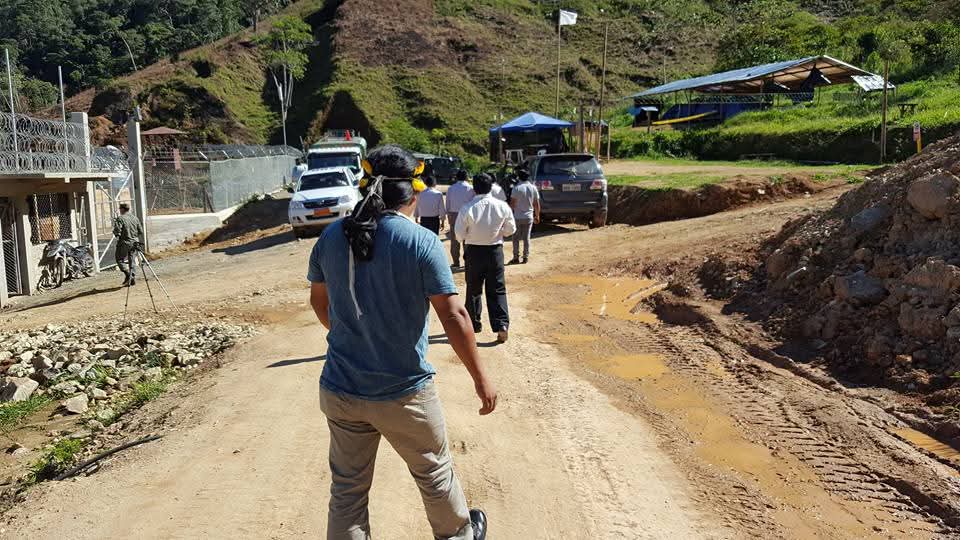
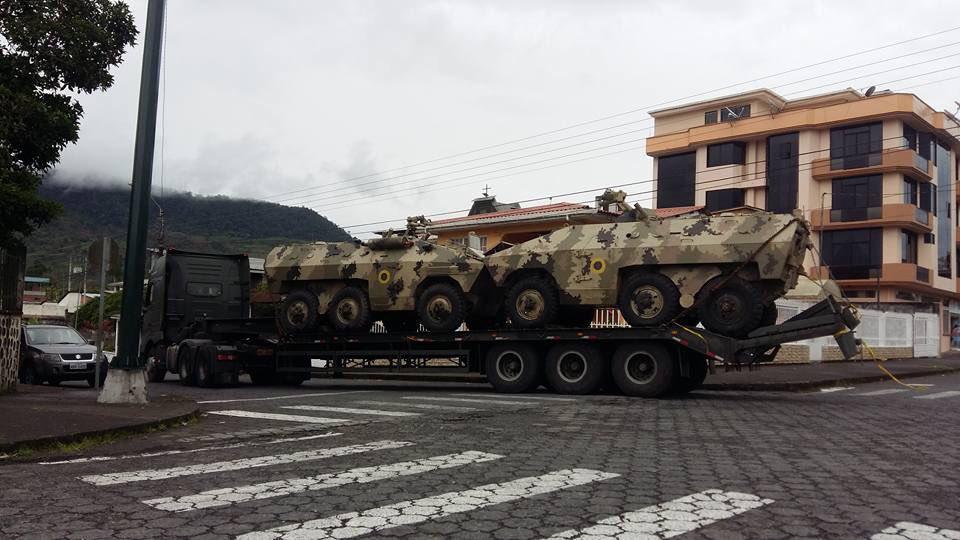
In the south-central Amazon, the San Carlos-Panantza mining project, operated by the Chinese company Explorcobres S.A. (EXSA), has become emblematic of this conflict. In August 2016, some 2,000 police and military personnel violently evicted eight Shuar families from Nankints. A subsequent confrontation at the La Esperanza mining camp led the government to declare a state of emergency, militarise the area, and target community leaders such as Agustín Wachapa. At least 35 Shuar families—including 46 children and seven pregnant women—were forced to flee into the jungle, seeking refuge at the Tlink centre under conditions of overcrowding, inadequate medical care, and children deprived of access to education.
“They are killing us; our river is contaminated with mercury, cyanide and fuel,” report the Kichwa communities.
“They are killing us; our river is contaminated with mercury, cyanide and fuel,” report the Kichwa communities.
In Zamora Chinchipe province, bordering Peru, projects such as Mirador and Fruta del Norte have exacerbated existing inequalities. Although mining attracted investments totalling USD 314.9 million in 2023, 52 % of the population live in multidimensional poverty. Between 2015 and 2017, at least 32 families were evicted from Tundayme without prior consultation. Shuar women, guardians of ancestral knowledge, face triple oppression based on gender, ethnicity, and the prevailing economic model, with 39.2 % living in poverty.
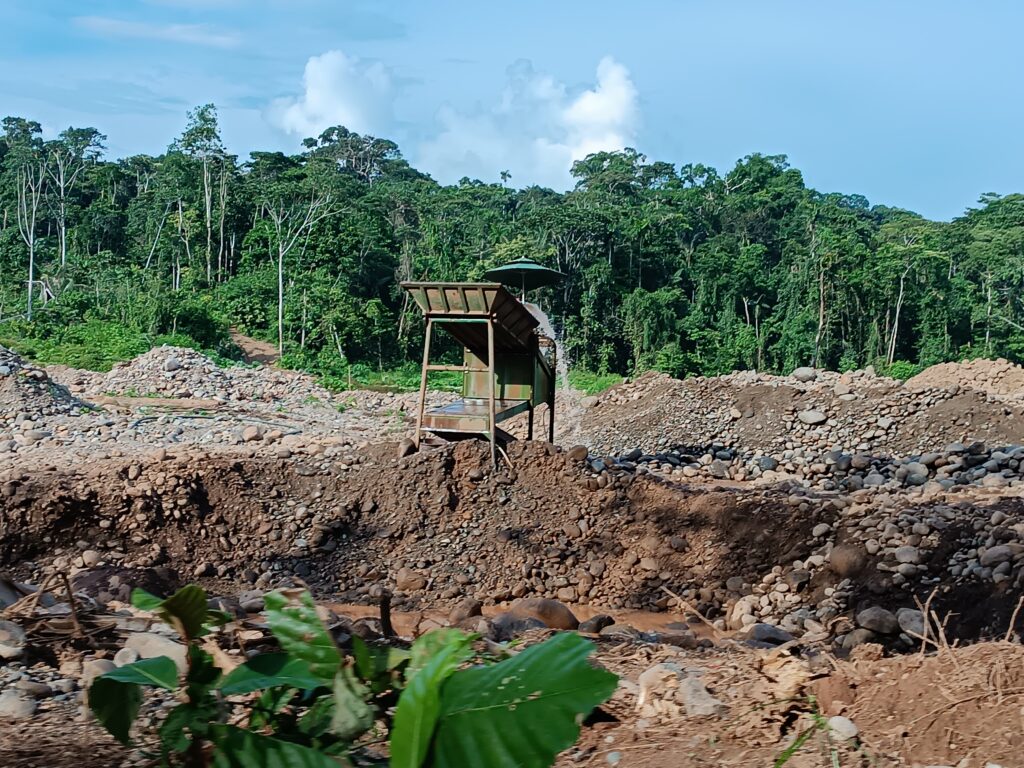
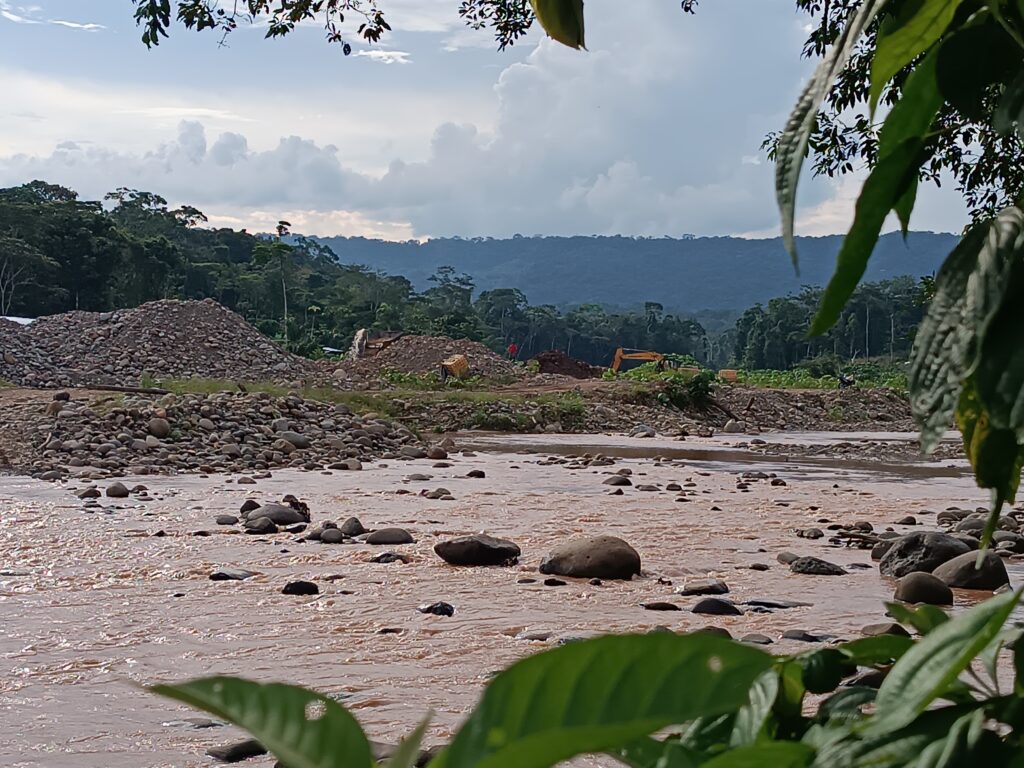
In the central province of Napo, both legal and illegal gold mining have devastated rivers such as the Anzu and the Punino, located within the territories of the Kichwa and Quijos peoples. The Chinese corporation Terracarth Resources operates under a legal framework that prioritises subsoil rights over Indigenous rights. Meanwhile, illegal gold mining linked to armed groups has led to the deforestation of 2,037 hectares and contaminated water sources with mercury. “They are killing us; our river is polluted with mercury, cyanide, and fuel,” report the Kichwa communities.
Mining and Drug Trafficking: From River Pollution to African Palm Cultivation
The case of the Carlos Julio Arosemena Tola canton is emblematic. Here, mining concessions have advanced into the ancestral territories of the Kichwa communities. Complaints by community leaders regarding the presence of heavy machinery and river contamination have gone unanswered by the State. “The institutions responsible for environmental oversight and natural resource management fail to exercise effective control and, in many cases, act as accomplices in the expansion of mining,” states a report by Ecuador’s Colectivo de Geografía Crítica.
This pattern of institutional complicity is repeated in other cantons such as Tena and Archidona, where mining companies frequently operate without complying with requirements such as prior, free, and informed consultation—a right enshrined in Ecuador’s Constitution. Communities are left to confront economically and politically powerful actors alone, while the State remains absent or acts as a mediator favouring corporate interests. One of the most serious consequences is the impact on water sources. The contamination of the Jatunyacu, Anzu, and Napo rivers affects not only biodiversity but also human consumption.
Leaders who resist the mining are threatened, suffer smear campaigns and unfounded legal proceedings.
Leaders who resist the mining are threatened, suffer smear campaigns and unfounded legal proceedings.
Furthermore, social organisation has undergone significant changes. The influx of external actors connected to mining has caused internal divisions within communities, with some viewing extractive activities as economic opportunities while others resist in defence of their territories. This tension frequently leads to intra-community conflicts and the criminalisation of land defenders. Even more troublingly, leaders opposing mining face threats, smear campaigns, and unfounded legal actions.
Drug trafficking similarly undermines Indigenous territories. Situated between Colombia and Peru, Ecuador has become a major cocaine trafficking hub. In 2020, 128 tonnes of narcotics were seized, while armed groups forcibly recruit Indigenous Awá and Siona peoples. Illegal mining and drug trafficking also intersect in Esmeraldas, a coastal province bordering Colombia, where African palm plantations are used to conceal coca crops. These activities displace communities and, in 2019 alone, destroyed 114 square kilometres of rainforest.
State Responses to Forced Displacement: Omissions and Challenges
The Ecuadorian State has implemented measures such as the VIRTE visa, which had regularised 95,809 people by 2024, and the Safe Mobility Initiative for refugees. However, these efforts stand in stark contrast to the absence of a unified registry of internally displaced persons—a critical gap that hampers the assessment of the crisis and the development of effective public policies. The Ombudsman’s Office has called for the establishment of such a system, yet progress remains minimal.
One of the greatest challenges is the criminalisation of Indigenous leaders who are defending their territories. The Confederación de Nacionalidades Indígenas del Ecuador (Confederation of Indigenous Nationalities of Ecuador / CONAIE) has documented cases of leaders accused of terrorism or sabotage for opposing megaprojects before the Inter-American Commission on Human Rights (IACHR),. CONAIE President Leonidas Iza stated: “They want to prosecute us for defending our territories. It is a strategy for sowing fear.” This persecution not only violates individual rights but also undermines community organisation.
According to UNHCR, Indigenous communities face barriers such as the lack of interpreters in native langugees and a longstanding distrust of institutions.
According to UNHCR, Indigenous communities face barriers such as the lack of interpreters in native langugees and a longstanding distrust of institutions.
Access to Justice Remains Limited. According to UNHCR, Indigenous communities face barriers such as the lack of interpreters in native languages and a longstanding distrust of institutions. Many victims are unaware of their constitutional rights, which exacerbates their vulnerability. Added to this is impunity: crimes committed by armed groups in border areas are rarely investigated.
In response to rising violence in the country, international organisations have issued key recommendations: 1) pass an internal displacement law with a differentiated approach for Indigenous Peoples, including humanitarian assistance and comprehensive reparations; 2) guarantee prior consultation in extractive projects, in accordance with ILO Convention 169, avoiding formalities and ensuring genuine participation; 3) establish a national victims registry, coordinated with the Ombudsman’s Office and UNHCR, to make this population visible and allocate resources efficiently.
Alternatives That Weave Hope
Meanwhile, displaced families across the Amazon, the Coastal Region, and the Andes endure precarious conditions, lacking access to healthcare and education, with little prospect of return. In response to the advance of extractivism and organised crime, initiatives such as that of the Shuar community of Kenkuim demonstrate that alternative mining models are possible. Their Exploken Minera project, a pioneering endeavour in South America, combines Indigenous autonomy with environmental sustainability by avoiding mercury use and prioritising the remediation of historical damages. “We do not use mercury. We are Shuar, and we protect our land,” states community leader Alipio Wajari.
Although not without internal tensions and economic challenges, this case represents a viable alternative to destructive extractivism, aligned with the principles of Sumak Kawsay and constitutional rights. However, such initiatives contrast sharply with the State’s absence and the lack of comprehensive policies to protect ancestral territories. While the State prioritises economic interests, communities resist: organising surveillance teams, promoting local economies, developing agroecology and community tourism projects, and demanding reparations for victims of forced displacement.
The gap between the constitutional rhetoric of Buen Vivir and the lived reality of these communities continues to widen. Organised crime not only exploits resources but also fractures the identity of Indigenous Peoples. Their struggle, marked by the defence of land and culture, is an urgent call to rethink development from the perspectives of environmental and gender justice. The path to a just transition requires recognising these violations as structural and supporting the grassroots alternatives that weave hope amidst crisis.
Pablo Ortiz-T. is a sociologist and holds a PhD in Cultural Studies. He coordinates the State and Development Research Group (GIEDE) at the Universidad Politécnica Salesiana, Quito campus, and is an associate researcher at IWGIA. Contact: portiz@ups.edu.ec