
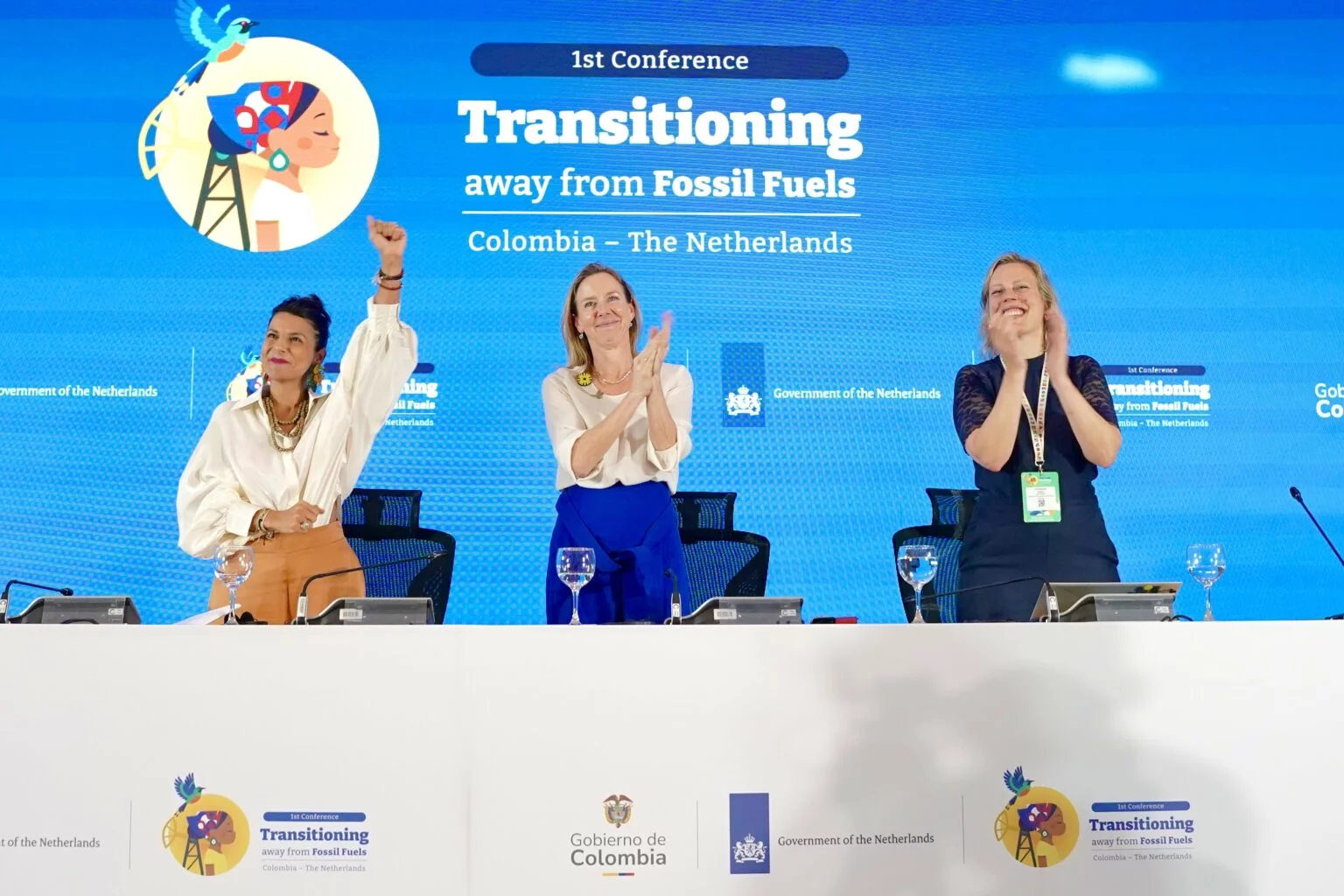
In response to COP30’s decision not to reference the extraction of oil, gas and coal, 24 countries convened the First International Conference on a Transition Beyond Fossil Fuels in Colombia. In doing so, they highlighted that a just energy transition requires far-reaching economic transformation, rather than merely a sectoral shift. For Indigenous Peoples, these debates are not abstract; they are lived realities shaped daily by the impacts of extractivism on their territories. In these discussions, their voices helped steer the debate towards territorial justice, the limits of carbon markets, and the risks of “green” extractivism.
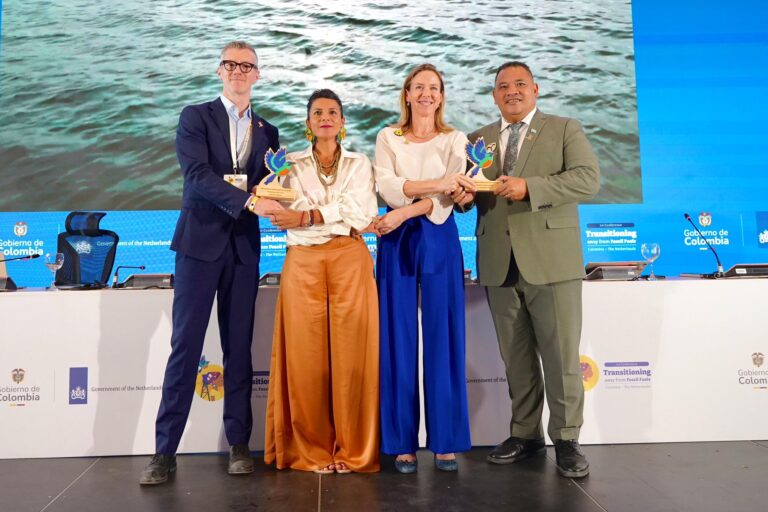
Between 24 – 19 April, 2026, Santa Marta, Colombia, hosted the First Conference on Transitioning Away from Fossil Fuels, a global gathering aimed at advancing concrete and just pathways to phase out oil, coal and gas while accelerating the shift towards equitable, low-carbon economies. Co-organised by Colombia and the Netherlands, the conference built on political momentum generated at COP30 in Belém, Brazil.
There, 24 countries reacted to the fact that the main decision – the Mutirão decision – omitted any direct reference to fossil fuels, reflecting opposition from several producer countries and persistent divisions among negotiating blocs. In response, these countries issued the Belém Declaration on the Just Transition Away from Fossil Fuels, calling for coordinated and collective action among states to expedite the phase-out of fossil fuels and to anchor climate action in science-based and rights-based approaches.
Meeting the objectives of the Paris Agreement and fulfilling States’ obligations to protect the environment – including through measures addressing fossil fuel production, licensing and subsidies – will require unprecedented international cooperation to ensure that no country or community is left behind. According the organisers, the conference was guided by a set of principles centred on action, scientific evidence and inclusive participation. It was conceived as a space for governments and stakeholders already committed to advancing a just, orderly and equitable transition away from fossil fuels, prioritising implementation and practical solutions rather than further diagnosis or persuasion.
A Climate Conference Focused on Fossil Fuels
The conference was also structured around three thematic pillars: overcoming economic dependence on fossil fuels, including fiscal dependence, energy security and economic diversification; transforming both supply and demand, through measures such as phasing out key demand drivers, managing exploration and extraction licensing, planning for the closure of fossil fuel infrastructure and redirecting subsidies towards clean energy investment; and advancing international cooperation and multilateralism to close governance and implementation gaps and address barriers in international law and finance that constrain the transition.
Unlike many previous climate summits, which often address multiple agenda items across mitigation, adaptation and finance, this event was singularly focused on fossil fuels. It aimed to convene governments, civil society, Indigenous Peoples, Afro-descendant communities, workers, youth, academia and private actors to co-design viable policies and roadmaps for moving beyond fossil energy.
This focus is critical because fossil fuels remain the single largest driver of global greenhouse gas emissions. Without targeted strategies to reduce both their production and use, limiting warming to 1.5°C is increasingly out of reach. Government projections indicate that planned fossil fuel production would exceed levels consistent with the Paris Agreement by more than 120% by 2030, and by 2050 output could be around 4.5 times higher than what is compatible with a 1.5°C pathway. These projections highlight the urgency of coordinated global action to phase out coal, oil and gas.
Implications for Indigenous Peoples’ Rights
One of the central aims of the conference was to convene a multi-stakeholder space bringing together governments, experts, civil society, and Indigenous and Afro-descendant peoples to exchange perspectives on pathways for a just transition. The conference was explicitly designed as a forum for dialogue and agenda-setting, where proposals—including the possible creation of a global expert panel to accelerate the transition away from fossil fuels—were put forward, though not formally adopted.. While this inclusive framing acknowledged Indigenous Peoples’ role and created some opportunities for their participation and visibility, it did not in itself establish concrete safeguards, decision-making authority, or accountability mechanisms to ensure that Indigenous rights are upheld in the transition process.
For example, Indigenous Peoples were recognised in the conference’s opening ceremony. Before the president, members of the Arhuaco Indigenous community from the Sierra Nevada de Santa Marta—who have a long history of protecting their ancestral territories from external development—opened the event with a traditional harmonisation ritual, a spiritual ceremony conducted in their language and accompanied by ancestral instruments.
A number of themes relevant to Indigenous Peoples were raised, including the need for meaningful participation in shaping transition strategies, recognition of Indigenous knowledge, and concerns about the socioeconomic impacts.
A number of themes relevant to Indigenous Peoples were raised, including the need for meaningful participation in shaping transition strategies, recognition of Indigenous knowledge, and concerns about the socioeconomic impacts.
In parallel, Indigenous delegations from the Amazon and other regions arrived at the conference explicitly to press for stronger action, reflecting long-standing frustration with the lack of meaningful commitments under global climate processes and calling for a rights-based transition that addresses the root causes of the crisis. However, these elements remained at the level of advocacy and political pressure, rather than commitments endorsed by states.
Rather than adopting negotiated outcomes, the Conference functioned primarily as a political and agenda-setting space that “will not yield binding agreements”. Within this context, a number of themes relevant to Indigenous Peoples were raised—particularly through Indigenous interventions—including the need for meaningful participation in shaping transition strategies, the importance of grounding energy transitions in human rights and justice frameworks, recognition of Indigenous knowledge and leadership, and concerns about the socioeconomic impacts of fossil fuel phase-out in affected territories. Indigenous representatives also stressed the importance of being included in any future efforts to define global pathways for ending fossil fuel extraction.
Conference Opportunities and Expectations
Indigenous representatives called on the Conference to explicitly reject the reproduction of extractive violence through “green” mining and to address the structural barriers to justice.Indigenous Peoples from the seven socio-cultural regions presented a consolidated position structured around the conference’s three pillars. Their proposals emphasise full respect for the right to self-determination and FPIC; legal protection of their territories, lands and waters; an end to both old and emerging forms of extractivism, including “green” mining and geoengineering; direct, accessible and sustained climate finance for Indigenous-led just transition strategies; and recognition of Indigenous knowledge systems and governance as foundational to climate action.
They further called for these standards and proposals to be explicitly reflected in the Conference’s final report, including minimum safeguards to ensure meaningful participation with decision-making power, protection for Indigenous defenders, traceability of transition-related investments, and guarantees for Indigenous energy security and sovereignty.
Participating countries agreed to develop national “roadmaps” to guide the transition away from oil, gas and coal, signalling a move from broad commitments to more operational planning.
Participating countries agreed to develop national “roadmaps” to guide the transition away from oil, gas and coal, signalling a move from broad commitments to more operational planning.
The conference signalled a partial shift in framing, with Indigenous Peoples acknowledged in the co-host “takeaways” document as participants in the process and, in some instances, as relevant actors in areas such as access to finance and community-level energy solutions. However, this recognition remains limited and largely instrumental: Indigenous Peoples are referenced alongside a broad range of stakeholders, with only cursory attention to their specific rights and roles. Notably, the document stops short of embedding core principles such as self-determination, FPIC, or the protection of Indigenous territories and governance systems as foundational to the transition. As a result, while the language gestures toward inclusion, it does not yet reflect a rights-based approach that positions Indigenous Peoples as central decision-makers in shaping equitable transition pathways.
Participating countries agreed to develop national “roadmaps” to guide the transition away from oil, gas and coal, signalling a move from broad commitments to more operational planning. Key outcomes included the establishment of three dedicated workstreams—on roadmaps, macroeconomic and financial dependencies, and producer–consumer alignment—alongside the launch of an international scientific panel to support evidence-based policymaking. The conference placed particular emphasis on the need to address the structural drivers of fossil fuel dependence, including fiscal constraints, debt burdens and asymmetries in the global financial architecture, underscoring that the transition requires far-reaching economic transformation rather than sectoral change alone.
Looking Ahead
While no binding agreements were adopted, the First International Conference on the Transition Away from Fossil Fuels convened more than 50 countries in a shared effort and helped reframe the global conversation towards concrete next steps, including subsidy reform, financial restructuring and strengthened international cooperation. Crucially, it underscored that the central challenge is no longer whether to phase out fossil fuels, but how to do so in ways that are coordinated, economically viable and grounded in justice — particularly for Indigenous Peoples and other frontline communities whose lands and livelihoods are most directly at stake.
The conference opened a potential new political space in global climate governance, placing fossil fuel phase-out at the centre of international discussion and foregrounding questions of justice, debt and development. Yet, as the cases presented make clear, political momentum alone is insufficient without structural accountability.
Indigenous Peoples were influential in shaping the tone and framing of the event, helping shift the discourse toward territorial justice, the limits of carbon markets, and the risks of “green extractivism”. Nevertheless, their influence remains uneven: they were not structurally embedded in decision-making processes, and no binding commitments emerged to safeguard their rights.

Rosario Carmona holds a PhD in Anthropology and works as programme consultant on climate with the International Work Group for Indigenous Affairs (IWGIA).