

Biodiversity offsetting, the main use by far of biodiversity credits, has been around for 40 years, with a very poor track record and well-known environmental and human rights issues. It is similar to carbon offsetting only worse because, instead of a few greenhouse gases, we are talking about millions of species with complex relationships that cannot be reduced to a few tradable assets. In addition, the risks of partial FPIC, unfair governance and revenue sharing, land-grabbing, and human rights abuses are similar to those of carbon offsetting.
Biodiversity markets are not a new idea. Biodiversity offsetting has existed since the 1980s and, indeed, the European Commission has shown an interest in biodiversity markets since 2010, originally under the name of “habitat banking”, an extreme version of biodiversity offsetting, which it subsequently tried – and failed – to introduce via a revision of the Habitats and Birds directives. The Commission is now promoting the transformation of EU conservation policies into financial markets for nature, under the new name of nature credits.
On the why, we are often told these days that the main obstacle to addressing the biodiversity crisis is a lack of funding for nature, that this funding gap is too great for governments alone to be able to close, that we consequently need to reorient private capital, and that the best way to do this would be via the creation of a financial market that trades in biodiversity credits. I find this narrative to be debatable and politically biased.
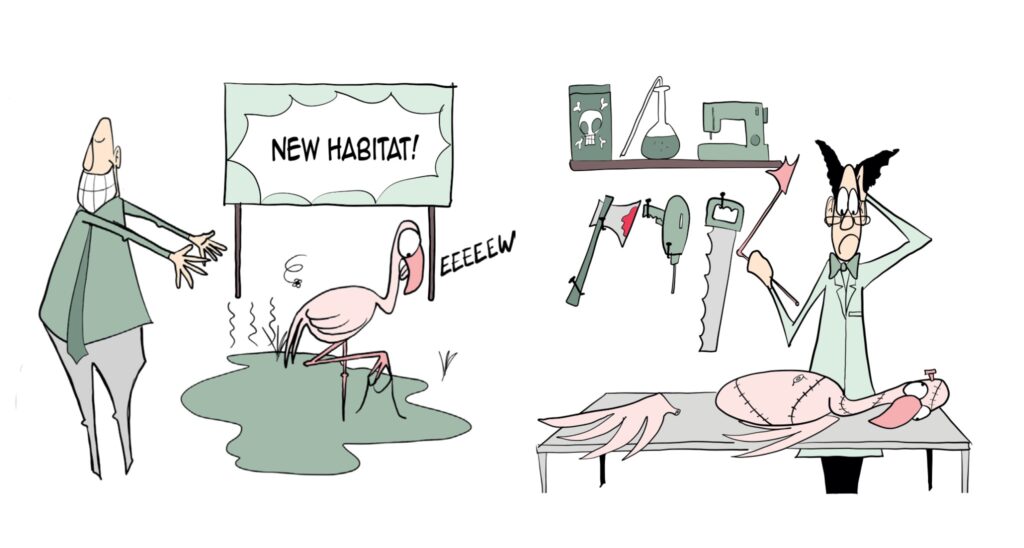
The False Funding Gap Narrative
First, the alleged US$700bn annual funding gap could easily be closed by redirecting a fraction of the existing US$1,700bn annual subsidies to harmful activities. This means that the funding gap could be entirely closed with public funding, without the need to raise taxes or increase deficits, meaning there is no need for private capital at all.
If a political choice is made to rely instead on private capital for conservation, then the most effective and fastest way to reorient private capital would be via environmental regulations that curb destruction. This is because any regulation will have an impact on the future expected profits of the sectors involved, and private capital flows will adjust automatically to the new profit expectations.
Creating a market for biodiversity credits is, therefore, arguably, the last and least effective option if the goal is to address biodiversity loss.
Creating a market for biodiversity credits is, therefore, arguably, the last and least effective option if the goal is to address biodiversity loss.
But even if we were to deem environmental regulations aligned to planetary boundaries too “coercive” and we chose instead to use only the carrot and no stick, it would still be far faster, more efficient and more cost-effective to do this via favourable tax or regulatory treatment rather than by creating a whole new financial market infrastructure based on a pseudo-commodity.
Creating a market for biodiversity credits is, therefore, arguably, the last and least effective option if the goal is to address biodiversity loss. Recent precedents such as the 2008 banking crisis, the Covid recovery plan, or the recent increase in EU defence spending also show that governments can find the money when they want to.

A Lack of Environmental Integrity
In terms of concerns over the creation of a market for nature credits, such a privatization and financialization of conservation policies would fundamentally change these latter by introducing a requirement for profitability. This would, in turn, result in weaker policies than if they were based on regulation. And we have already seen the deleterious consequences of financialization in other areas such as healthcare, education, and housing. Nature credits would also mean a transfer of sovereignty from the State to the financial markets, the priorities of which are unlikely to match ecological priorities, thereby threatening our future and survival.
There is also a fundamental contradiction between the need for a large number of credit types to reflect the large number of species, and the need to transform millions of species into a handful of types of credit in order to have a liquid financial market in which buyers and sellers can easily find trading counterparts. Such a level of simplification is not compatible with environmental integrity.
This makes biodiversity offsetting not “better than nothing”, as is sometimes said, but worse than nothing, as it helps maintain a social licence to destroy, and reduces public pressure for real solutions by giving the illusion that the issue is being addressed.
This is why biodiversity offsetting has had such a poor track record in past decades.
Crucially, I fear that biodiversity credits will also be used largely for offsetting purposes as there is no other business case on this scale. The European Union’s roadmap already places nature credits beyond the mitigation hierarchy —the framework that prioritises avoiding environmental harm first, then minimising, restoring, and only as a last resort offsetting residual impacts. This culminates in offsetting, thereby reinforcing and legitimizing it, particularly as the current balance of political forces is likely to push the EU to align with the International Advisory Panel on Biodiversity Credits framework, which explicitly accommodates offsetting.
And yet there is a scientific consensus on the fact that biodiversity offsetting is not possible in most cases, as our scientific knowledge is incomplete, the science of restoration is in its infancy, and it is simply not possible to transform millions of species into a handful of liquid tradable assets. This is why biodiversity offsetting has had such a poor track record in past decades. This makes biodiversity offsetting not “better than nothing”, as is sometimes said, but worse than nothing, as it helps maintain a social licence to destroy, and reduces public pressure for real solutions by giving the illusion that the issue is being addressed.
The First Scandals Are Already Emerging
I fear that biodiversity credits and offsets will primarily take place in the Global South, under the argument that this is where you find the most intact biodiversity. In reality, however, it will also be because land is far cheaper, as a consequence of colonialism. This will lead to the same land-grabbing, tensions, and human rights abuses that have been documented with carbon offsets.
This is in addition to the fact that getting paid to protect nature somewhere in order to enable its destruction elsewhere could well stand in contradiction to the values and worldview of many Indigenous Peoples and communities. Many Indigenous Peoples understand land, waters, animals and plants as kin, or as part of a living territory, not as external “natural capital” or a bundle of “ecosystem services”. Moreover, market‑based schemes risk subordinating Indigenous territorial governance to distant financial actors and State agencies, effectively recentralizing control over territories that Indigenous Peoples have struggled for generations to defend.
The revenues can be very useful for some Indigenous communities. However, as always, the devil is in the detail: what proportion of the governance body is made up of Indigenous representatives, and do they receive at least 50% of the revenue, for example?
The revenues can be very useful for some Indigenous communities. However, as always, the devil is in the detail.
While there is currently a big push to involve Indigenous Peoples and other forest-dependent communities in the various international biodiversity credit initiatives, I understand this to be more for communication purposes than a desire for real co-design and fair sharing of decision-making power and revenues. Getting a few Indigenous leaders on board is a great and cheap way to avoid accusations of green neocolonialism, and to divert attention from the lack of environmental integrity in these schemes. This is because the conversation now becomes one of “look at these poor farmers that we’re helping with our good hearts, how dare you criticize biodiversity credits and take these revenues from them”.
To be clear, I appreciate that the revenues can be very useful for some Indigenous communities. However, as always, the devil lies in the detail: what proportion of the governance body is made up of Indigenous representatives, and do they receive at least 50% of the revenue, for example? Furthermore, biodiversity credit and offset projects are often promoted in situations where communities are under strong economic and political pressure to accept them, and this can effectively undermine the right to Free, Prior and Informed Consent (FPIC), turning “consent” into coercion.

The Impact on Indigenous Self-Governance
I would like to emphasize two points: firstly, I understand the current emphasis on Indigenous participation as indicating that a vast proportion of biodiversity credit/offset projects will take place on Indigenous Peoples’ territories rather than in the countries of the Global North. Secondly, I want to caution against the promises of revenues from the sale of these credits. These are hypothetical revenues that will likely be extremely volatile, as they are based on financial market prices, and could easily disappear once political leaders in the Global North no longer see a need to pretend to address the biodiversity crisis. In fact, the UK provides a textbook example of such a risk. After starting a mandatory biodiversity offset market in 2024, leading many to start restoration projects, and farmers and landowners to expect revenues, in 2025 the government introduced an alternative: real estate developers will now have an alternative to offsetting 110% of their residual destruction of nature, by paying a one-off fee into a conservation fund.
If markets collapse, communities may be left without a stable income and unable to return to their traditional livelihoods – pressured instead towards dispossession or further commodification of their lands just to survive.
If markets collapse, communities may be left without a stable income and unable to return to their traditional livelihoods.
The consequences could be especially severe for Indigenous Peoples: long-term contracts may restrict land use and governance while promised revenues are often short-lived and uncertain. If markets collapse, communities may be left without a stable income and unable to return to their traditional livelihoods – pressured instead towards dispossession or further commodification of their lands just to survive.
There is already a growing number of scandals linked to biodiversity credits and these point to deeper structural problems. They include TotalEnergies destroying a national park in Uganda to drill oil and claiming to offset, and Eiffage building a dam in the Ivory Coast and destroying the forest and protected species while falsely promising no net loss. Similar patterns are emerging elsewhere: in Mozambique, TotalEnergies’ megaproject has been associated with misleading environmental claims while, in Guinea, mining projects backed by international financial actors have been linked to large-scale ecological damage framed through compensatory mechanisms.

Who Is Promoting These Markets and Why?
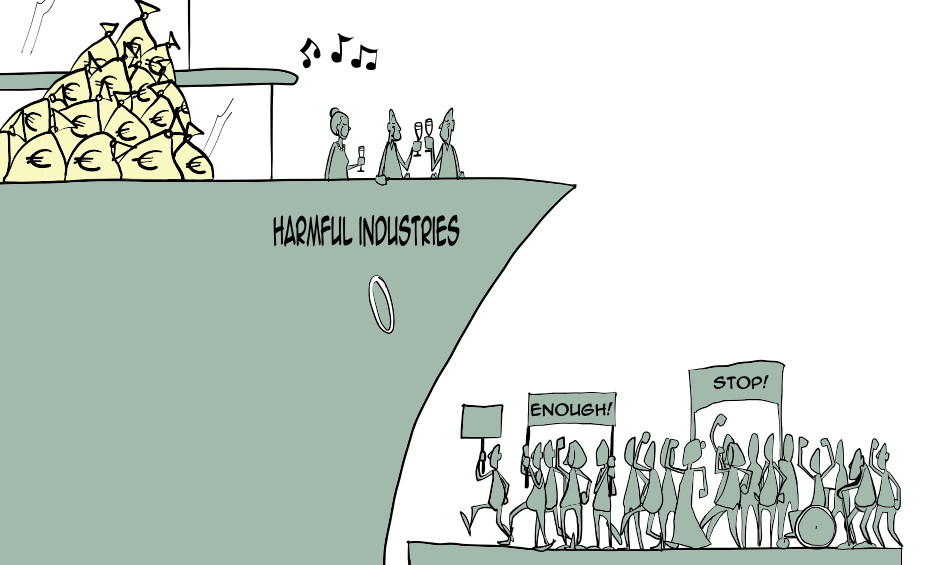
Why then are these markets being promoted, knowing that they will likely be an environmental failure, just like carbon offsetting before them? I understand the primary political goal as one of protecting the status quo for a few more years. These markets give the illusion of action while avoiding any confrontation with the private interests that are currently benefiting from destruction, including mining, agribusiness, infrastructure, and real estate, and avoiding any questioning of outdated and unsustainable economic paradigms.
Put another way, I understand that the European Commission does want to address the biodiversity crisis but only to the extent that it does not get in the way of short-term economic growth and competitiveness, which remain its overarching priorities. I also fear that this market could be instrumentalized to dismantle EU environmental regulations even further, by claiming they are no longer needed as they have been replaced by this market. In a way, this is very similar to climate politics, and carbon offsetting in particular, which are both an environmental failure and a political success, as they have successfully delayed meaningful climate action for many years.
Moreover, these new markets are also not without risk for potential private investors, who will be exposed to massive levels of regulatory and reputational risk surrounding this pseudo-commodity. Recent events in the UK have also highlighted the risks of expecting to earn a stable income from the sale of biodiversity credits.
The primary objective of promoting these markets is to maintain the status quo. Image: Frédéric Hache
The Solutions Are Well-Known
What is needed instead is a shift in existing harmful subsidies and a tightening of environmental regulations in order to address the root causes of biodiversity loss and align with planetary boundaries. We know, for example, that the global food system is the primary driver of biodiversity loss through deforestation to raise livestock. The solution, according to the EAT-The Lancet Commission, is to cut food waste and change diets, incentivizing this by a shift in agricultural subsidies, a tax on unhealthy foods and regulated advertising. This would massively reduce deforestation, cut greenhouse gas emissions, and reduce water pollution from overuse of pesticides.
Another central pillar of an effective biodiversity strategy is the recognition and reinforcement of Indigenous stewardship. Securing collective land titles, recognizing Indigenous legal and governance systems, and providing stable, unconditional public support for Indigenous‑led conservation and territorial defence are among the most effective measures a government can take. The other root causes of biodiversity loss, such as overexploitation of natural resources, climate change and pollution, should likewise be addressed by gradually changing the way we consume, eat and travel, and by putting in place regulations, including to cut plastic production. This would, of course, require confronting private lobby groups such as industrial food and farming, and the current political momentum for this is not great.
I take comfort, however, in the fact that the history of social and environmental progress shows several examples of how transformative change has occurred despite unfavourable political contexts — from the trade union movement to the suffragettes, from the US civil rights movement to the environmental movement, as well as the longstanding struggles of Indigenous Peoples to defend their territories. I also take comfort in the fact that several recent surveys show that a majority of citizens worldwide are already on board, willing to change the way they work and live in order to address the climate crisis. Given enough awareness, they would likely show the same support for addressing the biodiversity crisis. The future has not yet been written; once grassroots organizing reaches a critical mass, we will eventually win.

Frédéric Hache built a career in investment banking and later worked on post-financial crisis banking regulation at the NGO Finance Watch. He currently focuses on the financialization of environmental policies at the Green Finance Observatory and serves as a part-time lecturer.