
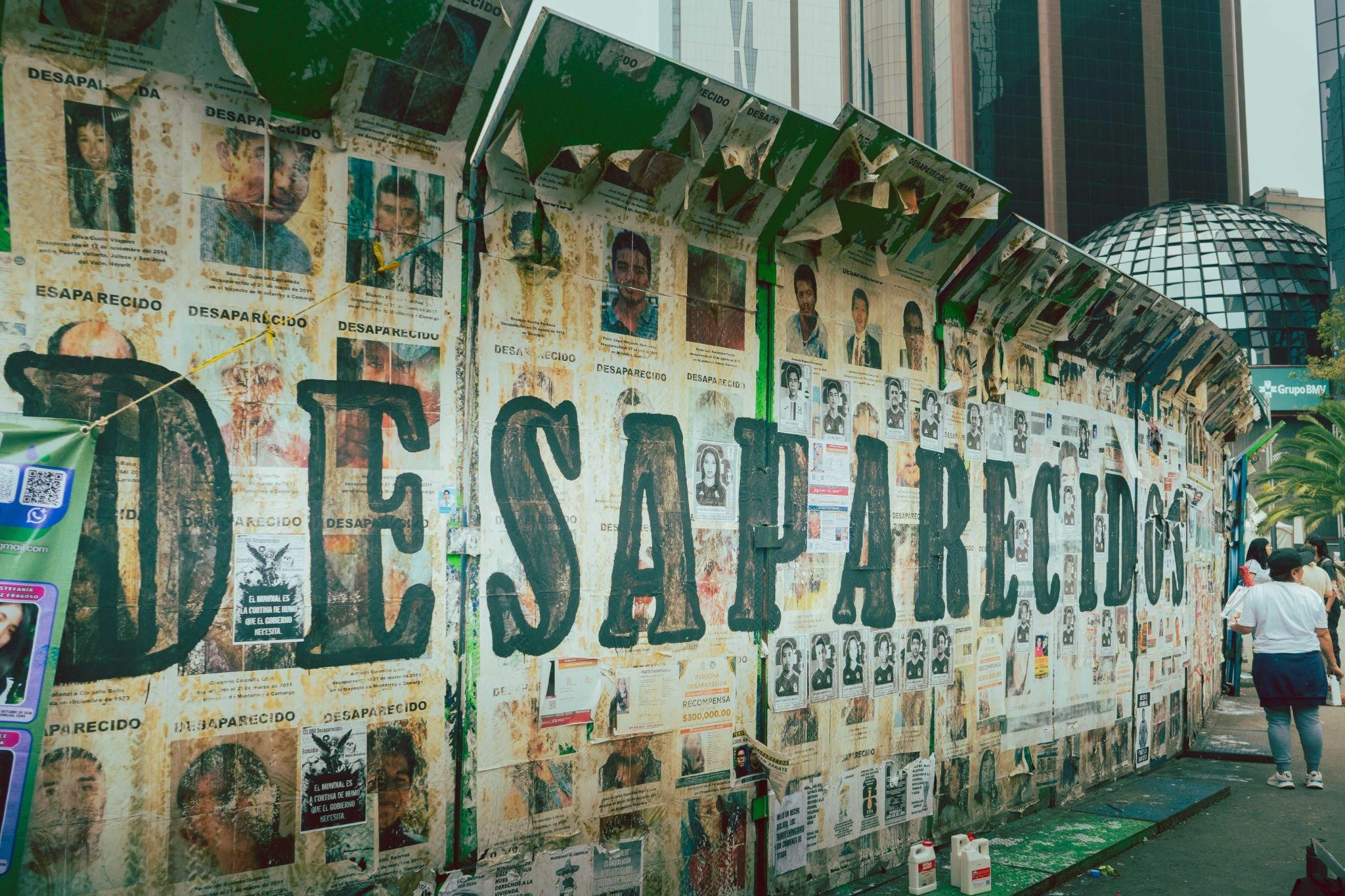
This title refers to the slogan that inspired the mobilisations led by families of disappeared persons in Mexico during the 2026 FIFA World Cup. These families reclaimed the official promotional messaging highlighting the country's hosting of its third World Cup. Currently, Mexico is experiencing one of the worst human rights crises in its modern history, even as it touches on the deepest chords of nationalism and unity through sports.
The existence of more than 133,000 disappeared persons has placed Mexico first in the region of Latin America for contemporary disappearances. This crisis, in turn, has given rise to a nationwide social movement of families who have formed search collectives and acquired forensic and legal expertise to carry out the work that the state has either been unwilling or unable to do. It is important to recognise that Mexico’s human rights crisis is not merely a “local problem” but part of a global culture of militarism in which the unregulated arms trade plays a central role.
Enforced disappearance is a form of continuous torture that was used against political dissidents and guerrillas in the 1960s and 70s, both in Mexico and in other regions of Abya Yala (the Americas). From 2006 onwards, however, it became widely employed by both state and non-state armed actors as a strategy of punishment, territorial control and terror, when then-president Felipe Calderón (2006–2012) launched what became popularly known as the “war on drugs”. This strategy militarised Mexican society, increased the circulation of firearms throughout the country, and incorporated methods of torture and body-handling techniques that the armed forces had learned in the context of armed conflicts.
While right-wing governments initiated the “war on drugs”, the centre-left governments of Andrés Manuel López Obrador (2018–2024) and Claudia Sheinbaum (2024– ) have continued this strategy, granting the Mexican military even greater power and impunity. Despite rhetoric placing the fight against inequality and the rights of women, victims and Indigenous Peoples at the centre of government policy, in practice these governments have continued implementing policies that militarise public security while enabling land dispossession and human rights violations by police, military and migration authorities. This was denounced by search collectives during their mobilisations during the FIFA World Cup.
More Than 70,000 Unidentified Bodies
Among the demands of this movement is the identification of the more than 70,000 bodies currently held by the state in morgues, forensic institutions, hospitals and prosecutors’ mass graves. With 133,000 people who remain disappeared and the remains of more than 70,000 individuals in state custody, families know that many of their loved ones could simply be waiting to be identified before they can finally return home. The state’s response has been that it lacks the financial and material resources needed to carry out this task. Alejandro Encinas, then Undersecretary for Human Rights, described this reality as “Mexico’s forensic crisis.”
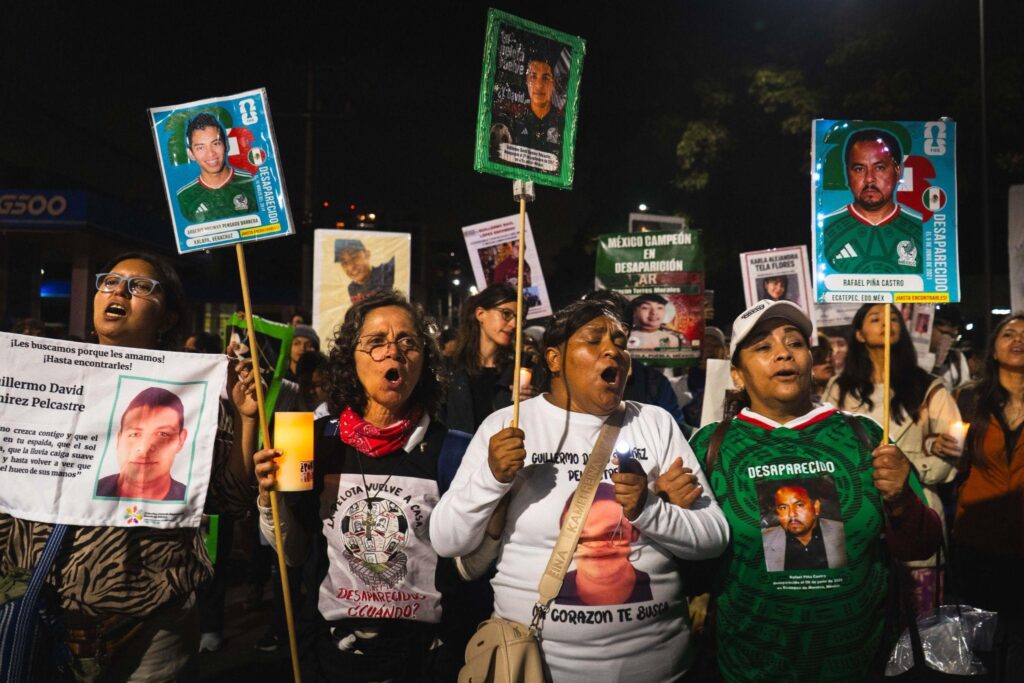
Yet the World Cup’s financial gain tells a different story. There may be no money to search for and identify disappeared persons, but there is enough to invest $1.323 billion in infrastructure projects to make the World Cup possible. Faced with this reality, groups of families of disappeared people took to the streets in the three World Cup host cities chanting: “Mexico, world champion in disappearances.” While the World Cup venues were filled with banners announcing the return of the ball home, the families demanded: “The ball is coming home, but when will our disappeared loved ones?”
Violence in Indigenous Territories: Dispossession and Disappearances
In the context of the FIFA World Cup, groups of families of disappeared people sought to expose another side of the so-called Fourth Transformation governments: centre-left governments that have continued policies of death and impunity, enabling the disappearance of 67,000 people in just the six years of López Obrador’s administration and the first two years of Claudia Sheinbaum’s. Although there are no precise figures indicating how many of those disappeared are Indigenous, as official data are not disaggregated by ethnic origin, we do know that extreme forms of violence tend to be concentrated in impoverished and racialised territories where Indigenous communities live.
The stories of Indigenous people who have disappeared in Sinaloa, Guerrero, Oaxaca, Michoacán, Chiapas and Chihuahua reveal a continuum of violence that includes the structural violence preceding enforced disappearance and forms part of the harm suffered by victims and their communities. Racism contributes to concentrating disappearances in the country’s poorest and most marginalised regions. Colonial structures assign certain bodies to particular territories, which receive fewer resources and less attention through public policy. In a racist and racialised society such as Mexico’s, Indigenous identity significantly increases the likelihood of experiencing violence. Reporting disappearances, searching for disappeared relatives, and accessing justice become even greater challenges for those who do not speak Spanish and have no access to interpretation services, as well as for families who lack the financial means to travel to the cities where judicial and search institutions are based.
This is the other side of World Cup Mexico that search collectives sought to reveal by taking to the streets and reminding football fans that, in the areas surrounding the stadiums, clandestine graves conceal the bodies of those who remain disappeared.
This is the other side of World Cup: in the areas surrounding the stadiums, clandestine graves conceal the bodies of those who remain disappeared.
This is why we speak of the multiple absences of disappeared Indigenous people. Beyond their physical absence from the communities to which they belonged, until recently their ethnic identity went unrecognised in official statistics on disappearances, while the issue itself remained largely absent from Indigenous mobilisations. Many of their bodies have ended up in state-run mass graves, with no forensic records that would allow their relatives to identify and recover them.
Alongside the thousands of anonymous Indigenous young people who have been forcibly recruited by organised crime and disappeared or murdered for resisting recruitment, there are documented stories of 46 Indigenous land defenders who, since 2019, have been murdered or disappearedfor defending their territories against dispossession driven by mining and other development projects. This is the other side of World Cup Mexico that search collectives sought to reveal by taking to the streets and reminding football fans that, in the areas surrounding the stadiums, clandestine graves conceal the bodies of those who remain disappeared.
Search Collectives and the World Cup
Mexico City hosted the opening ceremony and opening match of the 2026 FIFA World Cup at the Estadio Azteca, a tournament venue located in Santa Úrsula Coapa, an Indigenous community whose territory was fragmented by the construction of the stadium. For the third time in its history, the community of Santa Úrsula has had to live through a FIFA World Cup while access to its territory has been restricted and disrupted. Furthermore, as in previous World Cups, the social context of Mexico is not what the government has tried to portray to the world.
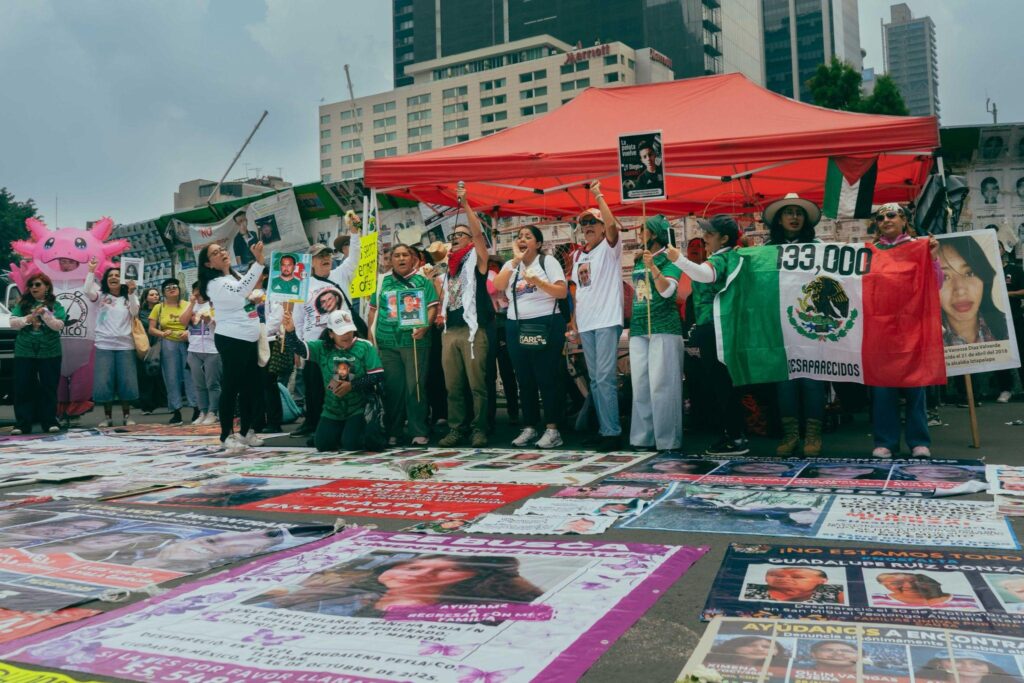
Faced with a city that has become increasingly hostile to its own residents and a FIFA under suspicion of corruption and influence peddling, those searching for their disappeared loved ones prepared a schedule of mobilisations and memorials to disrupt the green grass of the host stadium and voice their demands for justice. Even in the face of threats and repressive actions by the authorities, they found a way to become part of the World Cup atmosphere without confronting it directly. As they themselves explain, their sons and daughters, husbands and wives, brothers and sisters, and friends are football fans too. That is why they took to the streets to say that there should not be another World Cup until their loved ones have finally come home.
These protests took place not only in Mexico City but also in Guadalajara and Monterrey—the three World Cup host cities in Mexico—and received widespread coverage in both the national and international press. Guadalajara attracted particular attention, not only because of the demonstrations themselves but also because search collectives documented the discovery of several clandestine graves in the vicinity of Estadio Akron.
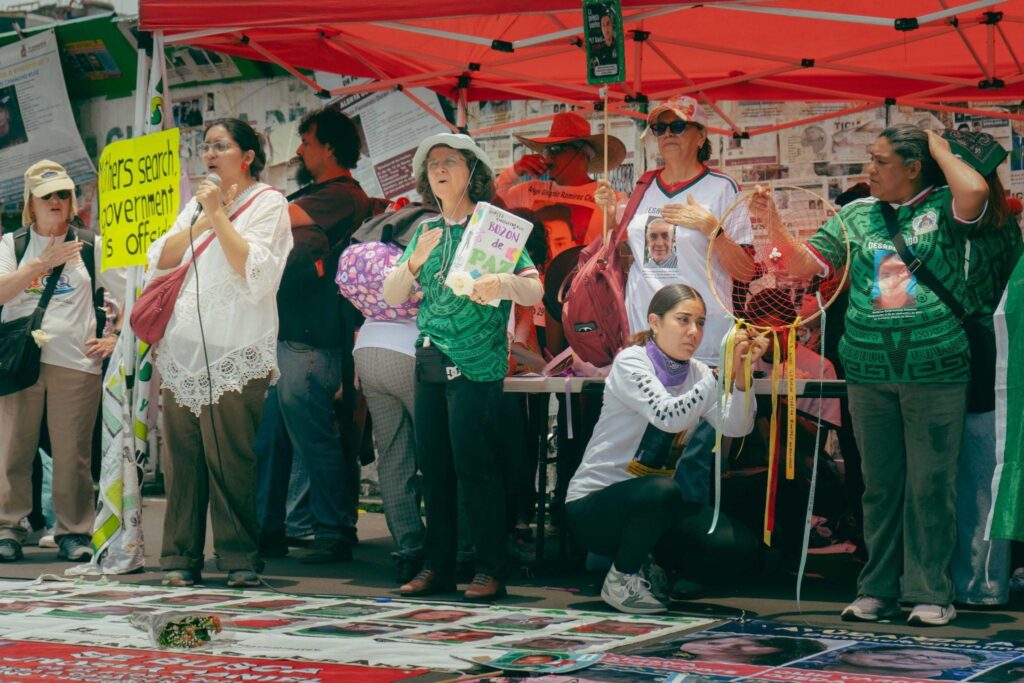
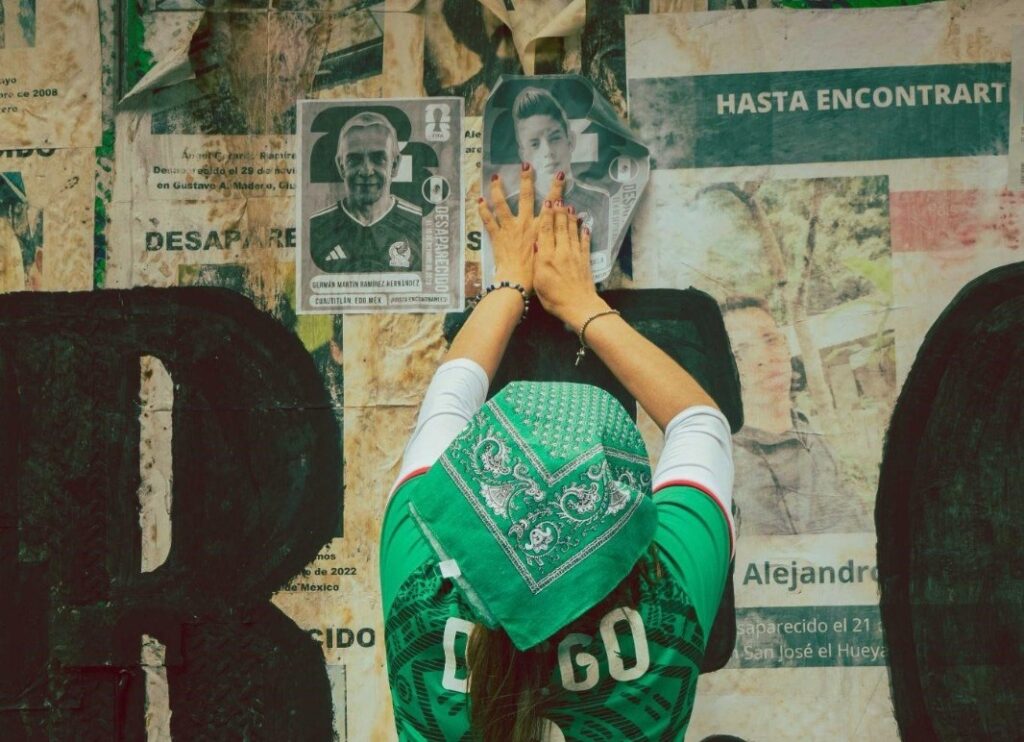
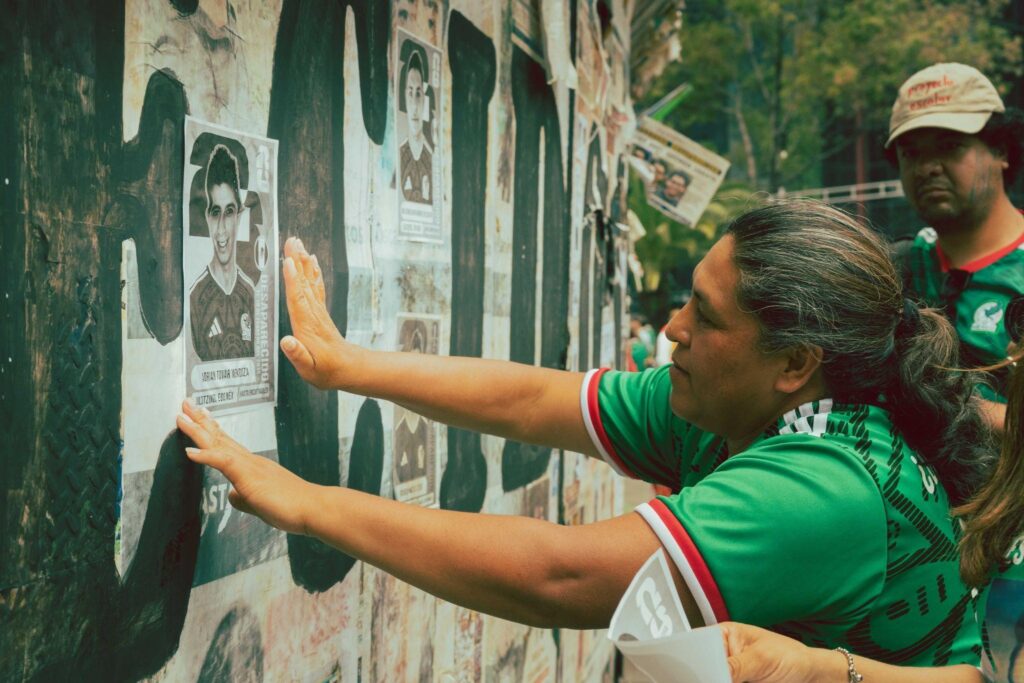
The families’ mobilisations took many forms: a march and overnight vigil on the eve of the opening match; the demonstration held on opening day, during which some families managed to reach the vicinity of the Estadio Azteca after crossing the police cordon that had prevented them from gaining access; visual interventions inspired by World Cup imagery; posters featuring the faces of disappeared people designed in the style of Panini World Cup stickers; large-scale campaigns to paste up posters featuring disappeared persons; cascaritas—the informal football matches played between friends in Mexico—held “for memory and against forgetting”; and the creation of the Searching Axolotl, a mascot inspired by the amphibian endemic to the lakes of the Valley of Mexico and revered as a deity in Mexica culture.
Faced with this series of protests, memorial events, cultural activities and interfaith gatherings, the federal government led by Claudia Sheinbaum responded in a way that few expected. It even suggested that the search collectives had received illicit funding to organise the demonstrations. Rather than committing to investigating the disappearances themselves—many of which occurred during Sheinbaum’s administration—the government announced that it would instead investigate the alleged source of that funding, a move the families denounced as a further act of revictimisation.
The official response consisted of hostile rhetoric, police cordons and repeated attempts to restrict the protests. One particularly troubling incident occurred when Mexico City police used force against search collectives and supporters taking part in a peaceful demonstration on one of the main avenues linking the city centre to the Estadio Azteca, on the day of the Mexico–Ecuador match. Fernando Vargas, the father of Olin Hernando Vargas, who disappeared in 2024, was injured during the operation. Meanwhile, the mobilisations for memory and against forgetting continue.
“Everyone to the Stadium!”: A Chronicle of the Night March Before the Opening Match
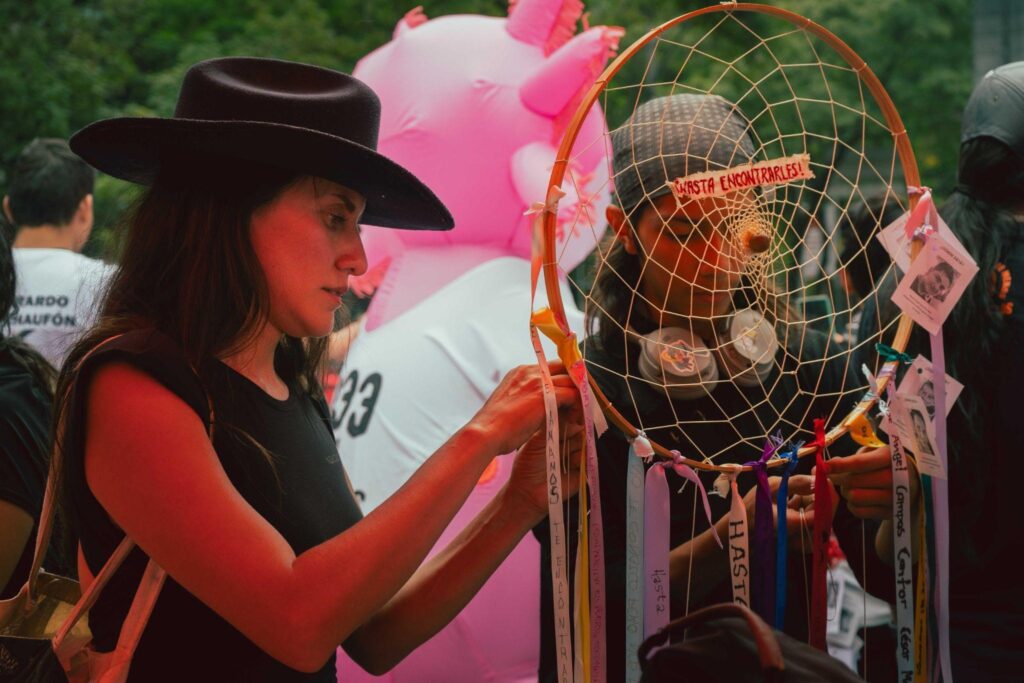
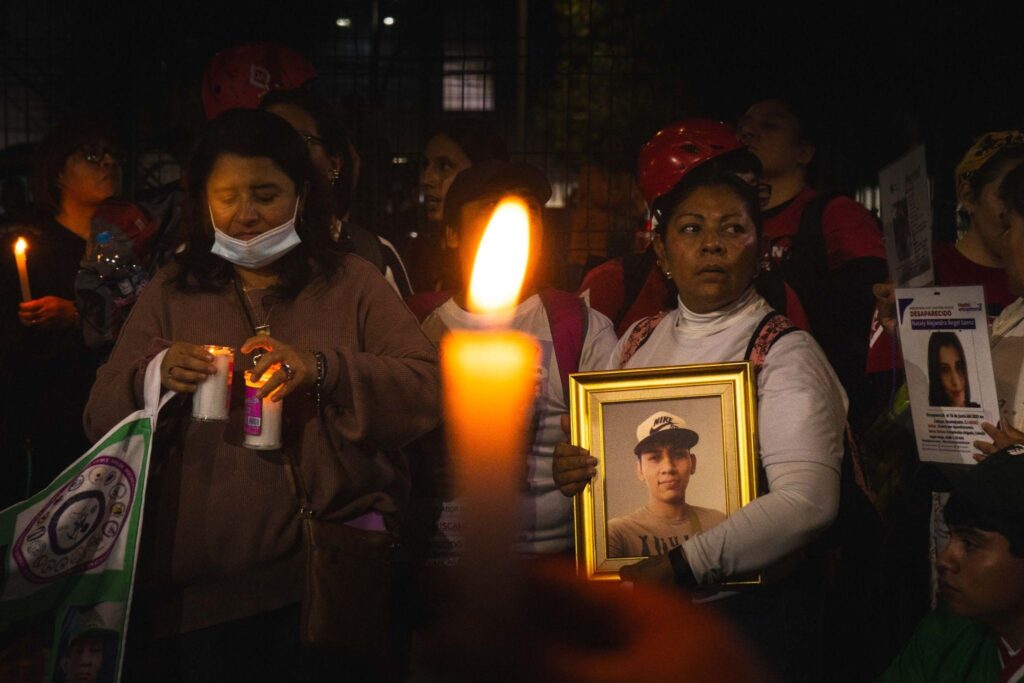
On 10 June 2026, a march took place in Mexico City under the slogan “Light the Way for the Search.” Setting off from the Registro Federal light rail station, participants aimed to reach the Estadio Azteca. At eight o’clock that evening, we began marching, accompanied by a massive presence of national and international media. One of the family members coordinating the event took the megaphone and called out: “We ask everyone to keep their faces uncovered!” The request underscored the peaceful nature of the demonstration and sought to prevent outside actors from discrediting its genuine purpose.
A few hundred metres before reaching the boundary of the “last mile”—a restricted security perimeter around the stadium, accessible only to local residents and ticket holders—the march became more cautious. The protesters linked arms and decided to keep moving. As we covered those final metres, an unfamiliar scene began to take shape in the distance. At the top of the avenue, a line of lights appeared to block the road. At first, some of us thought they were the flashes of journalists’ cameras. But as we drew closer, the picture became clearer. At least ten rows of police officers stood across the road, blocking our way, while the streetlights reflected off their riot shields. On one side stood the police line; on the other, the families, raising their megaphones and chanting: “Why do we search for them? Because we love them!”
When we came face to face with the police lines, the families kept their spirits high. Some sang and prayed together, while others improvised an altar where they placed the candles carried during the march. Others organised cascaritas—informal football matches—right there in the middle of the road. Gradually, as the night wore on, the crowd began to disperse and the area around the stadium emptied. Yet just as the World Cup was about to begin, so too did the protests that surrounded it.
“Let’s Make It Happen!”: The Cascarita for Memory and Against Forgetting
Near the Glorieta de las y los Desaparecidos—renamed by families searching for their disappeared loved ones—the asphalt has spontaneously become the football pitch where today’s match “for memory and against forgetting” is being played. White paint marks the boundaries of the field, while a couple of backpacks serve as the goalposts. The players wear Mexico national team shirts that have been altered to raise awareness and protest the situation: some bear the names and faces of disappeared persons; others display messages denouncing the country’s disappearance crisis. The teams are not playing against one another. Instead, they play together to “score against forgetting.” Every goal scored is a goal for memory.
Among the players and spectators, banners and placards bear the names and faces of those who remain disappeared—the people for whom this cascarita is being played. Verónica, Benita and Dioni, members of the Uniendo Esperanzas search collective, play for one of the teams. Their shirts carry the names of their sons who have disappeared: Diego Maximiliano, Fernando Iván and Guillermo David. Their side is completed by Leo, Benita’s young grandson, together with a group of young women and men who stand alongside them in the search for their children. They play with skill and determination, giving everything they have on the pitch.
The cascarita for memory and against forgetting—for truth and justice—continues until every one of those who remain disappeared has been found.
The cascarita for memory and against forgetting—for truth and justice—continues until every one of those who remain disappeared has been found.
The match goes on and the scoreboard is still active. The teams take turns on the pitch. Every goal is celebrated. Every act of solidarity counts; every lack of it is ruled offside. At one tense moment in the match, Sister Pao—a volunteer referee and Catholic nun who accompanies the families searching for their disappeared loved ones—firmly brandishes a red card against injustice. She quickly puts the ball back into play, not before reminding everyone that this is a collaborative match. Among the players are people who also give everything they have in support of other just causes. Collaboration between all those on the pitch is the key to scoring goals for justice.
Just before the rain begins, the last goal of this day of Mexican street football is scored. The cascarita comes to an end. Players run for shelter wherever they can. But the main match is far from over. That is the match the families searching for their disappeared loved ones play every single day. The cascarita for memory and against forgetting—for truth and justice—continues until every one of those who remain disappeared has been found.
The Chance to Play One More Match
During the 39 days of the FIFA World Cup, families searching for their missing loved ones never stopped raising their voices, scoring goals for remembrance and reminding the public that Mexico remains fractured and incomplete: more than 133,000 people remain disappeared. In the face of a football-centred nationalism that often showed little empathy for the families’ pain, search collectives revealed another side of World Cup Mexico. Faced with a government and a society that continue to deny the country’s disappearance crisis, these families continue to lay bare the face of a profoundly wounded Mexico.
Indigenous territories continue to be dispossessed, occupied and transformed into football stadiums or clandestine cemeteries, while the government floods the media with Indigenous rhetoric about laws and public policies that do not respond to the realities of dispossession, violence and impunity experienced by Mexico’s Indigenous Peoples.
While the country continues to conceal the scars left by disappearances, clandestine graves and countless human rights violations, families searching for their disappeared loved ones refuse to let the names and faces of the more than 133,000 people who remain disappeared fade from public memory. Their protests and mobilisations are acts of remembrance against forgetting. Let us hope that each of these absences will be remembered not only by the families who search every day, but also by all those who believe that everyone deserves a fair chance, a dignified remembrance, and the equal opportunity to watch—or even play—one more match with the people they love.
Andrea de la Serna Alegre is a Postdoctoral Researcher at the Institute for Legal Research of the National Autonomous University of Mexico (UNAM). She holds a PhD in Anthropology from the Centre for Research and Advanced Studies in Social Anthropology (CIESAS) in Mexico City and specialises in legal anthropology, political anthropology and the anthropology of the state. Her work focuses on state anthropology, as well as violence and disappearance in Mexico.
Rosalva Aída Hernández Castillo (CIESAS–Mexico City) is Professor and Researcher at the Centre for Research and Advanced Studies in Social Anthropology (CIESAS). She is a member of the Hermanas en la Sombra Editorial Collective and the Latin American Anti-Prison Feminist Network.
Omar Tapia is an evangelical pastor and clown who works with the Iglesia Misión faith community in Mexico City. He accompanies collectives of families of disappeared people in Mexico and is a member of the Churches and Spiritualities in Search network, an ecumenical collective bringing together people from different faith traditions and communities who support families searching for their disappeared loved ones.